


Stop Funding Collections. Start Deleting Them.
Stop Funding Collections. Start Deleting Them.
Module 4:
You paid the collector. You waited. Your score didn’t budge.
That sting? It’s common—and predictable. On your credit file, a paid collection still reads as a collection. Same scar. Same drag. It can sit there for up to seven years from the original delinquency date and keep pricing your life higher—cards, cars, apartments, all of it.
So quit paying for scars. Start aiming for disappearances.
This module is a playbook, not a pep talk. You’ll use it to replace blind payments with targeted deletions, then redirect cash toward the balances that move your score the fastest. No mystery. Just leverage, timing, and a paper trail that puts you in control.
⸻
What You Actually Want: Erasure, Not Closure
“Settled.” “Paid.” “Closed.” They sound tidy. They’re not. Lenders and scoring models still see the derogatory. The balance hitting zero doesn’t erase the history that got reported. You need the entry gone—removed from all three bureaus—so underwriters never see it and the algorithm never weighs it.
That’s deletion. You can negotiate for it.
⸻
Pay-for-Delete: The Quiet Power Move
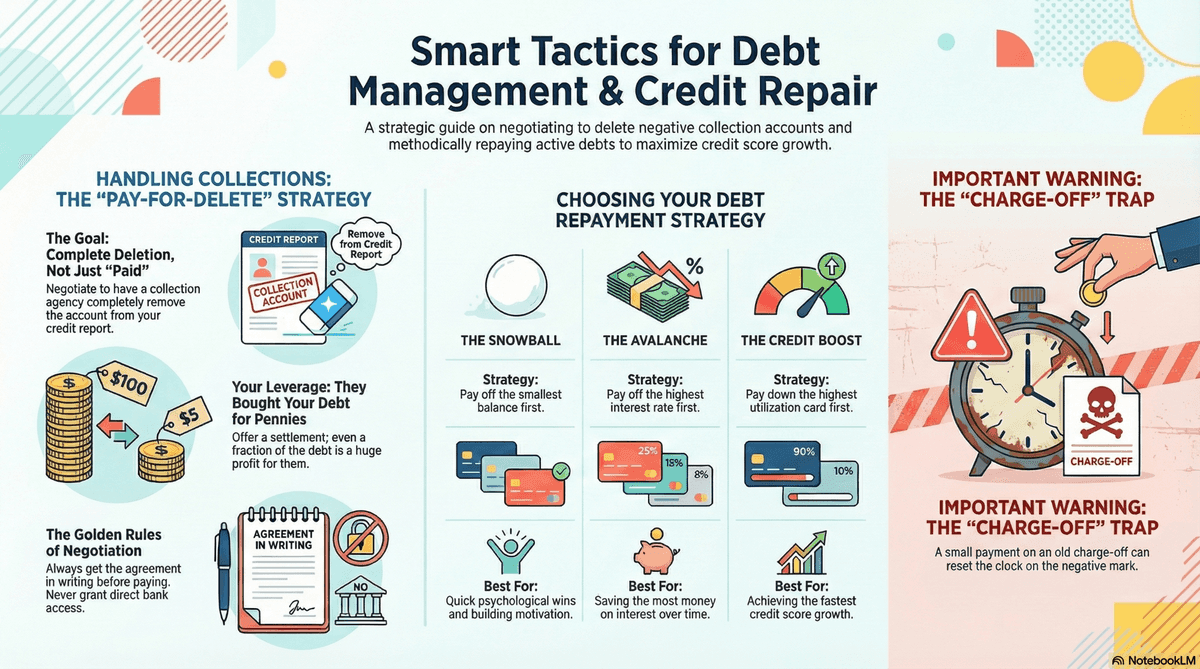
A pay-for-delete (PFD) agreement trades money for removal. Not “update to paid.” Not “we’ll report favorably.” Removal. From Equifax, Experian, and TransUnion.
Why a collector would agree:
- They often buy debt for cents on the dollar.
- Your offer can be many multiples of their cost.
- They get revenue today; you get a clean file tomorrow.
Example: you owe $500. The agency may have bought the account for $20. Your $200 offer deletes the trade line and still leaves them with a solid margin. You’re not powerless here. You’re negotiating from strength—if you do it correctly.
⸻
The Three Golden Rules of PFD
- Get it in writing—first.
No verbal agreements. No “we’ll note your file.” You want a letter on company letterhead that explicitly states: upon receipt of $X by date Y, the agency will request deletion of the account from all consumer reporting agencies. Name the bureaus. Reference the account number.
- Pay without giving access.
Never hand over your debit details. Don’t set up an ACH pull. Use a money order or cashier’s check. Put only the account number in the memo. Keep the stub and a copy of the letter in your file.
- Don’t admit ownership.
Language matters. Use:
“I am not acknowledging this debt. As a compromise to resolve any claims, I am offering $____ in exchange for deletion from all consumer reporting agencies.”
You’re offering a business settlement, not confessing.
⸻
How to Negotiate Without Blinking
- Start below your ceiling. If you can pay $300, open at $120–$150. Expect counteroffers.
- Stay boring. No long stories. Two-paragraph letters. Facts, not feelings.
- Set an expiration. “This offer is valid for 15 days from receipt.” Deadlines move files off desks.
- Use Certified Mail. Return Receipt Requested. You want delivery confirmation and a chain of custody for every promise.
When the agreement arrives, read it like a lawyer. Look for the words delete/remove, not “update,” “satisfy,” or “paid in full.” If they won’t put “delete” on paper, walk. You’re not buying a new label for a bad record.
⸻
If They Say No
Some agencies won’t do PFD. Fine. You still have options:
- Dispute factual errors. Dates, balances, statuses, creditor names—anything that doesn’t match across bureaus or documentation. Target facts, not narratives.
- Leverage the furnisher. If the original creditor still reports anything after a sale—especially a balance—demand correction to $0 with exhibits.
- Let sleeping accounts sleep if they’re near the end of their reporting window and you have no legal exposure. Don’t kick dust just to feel busy.
⸻
The Three Debt Paydown Plays (For Active Accounts)
Clean up collections and your file stops bleeding. But to climb, you also need to manage open balances. Pick a lane based on your goal, not someone else’s blog.
1) Snowball (Momentum)
- Move: Pay off your smallest balance first while making minimums on the rest.
- Why: Quick wins. You eliminate an account entirely, free up cash flow, and build a rhythm you can keep.
2) Avalanche (Math)
- Move: Attack the highest interest rate first.
- Why: You cut the most expensive interest and save the most money long term. Cold, efficient, effective.
3) Utilization Drop (Speed)
- Move: Pay down the account with the highest utilization (balance ÷ limit) first—especially cards reporting over 30%, and definitely over 50% or 75%.
- Why: Utilization drives roughly a third of many scoring models. Lowering reported balances before statements cut can lift your score within a cycle. If you need movement fast, this is the lever.
Pro tip for speed runs: note each card’s statement date and push payments 3–5 days before it. The number that reports is the number on statement day, not the random Tuesday you paid.
⸻
Beware the “Good-Faith Payment” on Old Charge-Offs
You found a five-year-old account. You think, “I’ll send $20 to show goodwill.” Stop.
Small payments can come with big consequences:
- In many states, paying an old debt can revive the collector’s ability to sue by restarting the statute of limitations clock.
- Activity can also ripple through how the account updates on your file, which can keep it visible and noisy when leaving it alone might be safer.
- The reporting window (often up to seven years from the original delinquency that led to charge-off) typically doesn’t reset—but poking a sleeping account can still invite fresh entries and attention.
Translation: don’t tap an old beehive without a plan. Confirm your state’s rules, weigh the age of the item, and prioritize deletions or precise disputes over random “good-faith” payments.
⸻
When to Talk, When to Stay Quiet
- Talk when you have a written PFD offer to make, a factual error to document, or a letter to send via certified mail.
- Stay quiet on the phone. Phone calls invite pressure, misstatements, and unrecorded promises. If you must call, keep it short: confirm a mailing address, ask for a compliance email, hang up, and put the rest in writing.
⸻
Building the Paper Trail That Wins
Your folder should read like a case file:
- A tracker with dates sent, tracking numbers, delivery confirmations, deadlines, and results.
- Copies of every letter you sent and received.
- Exhibits labeled “A, B, C”—highlighted report pages, screenshots with timestamps, statements that disprove balances, and any prior correspondence.
- Payment proofs (money order stubs, cashier’s check copies) stapled to the corresponding deletion letter.
If you ever need to escalate—to a bureau, a regulator, or counsel—you already have the record.
⸻
What Happens After a Deletion Agreement
- You pay as agreed—clean instrument, no account access.
- They request deletion with the bureaus.
- You monitor your reports. Allow 30–45 days for the deletions to propagate.
- You verify the line is gone from all three. If it isn’t, send a short, firm follow-up with your PFD letter and proof of payment attached. One page. Three exhibits. Certified.
If an agency marks “paid” instead of deleting—despite the agreement—your paper trail does the talking. Quote the line that promised deletion, attach exhibits, and demand correction.
⸻
What If the Debt Is Still With the Original Creditor?
Pay-for-delete usually lives in collections land, but you still have levers:
- Goodwill adjustments for late payments after long stretches of perfect history—polite, specific requests to a supervisor or executive support team.
- Direct disputes on factual errors (limit missing, misreported dates, double-counted lates).
- Product changes or balance transfers that improve utilization without opening brand-new tradelines every month.
None of this replaces paying what you owe. It replaces sloppy reporting with accurate reporting—and shaves the drag where you can.
⸻
A Quick Word on Medical Collections
Policies around small-dollar medical collections and how they report have shifted in recent years. Before you pay anything, verify what’s actually reporting and whether the furnisher has already agreed not to report balances under certain thresholds. Don’t assume; check. Then choose between deletion negotiations and direct disputes on coding errors.
⸻
Script for a Clean PFD Letter (Use, Don’t Worship)
Keep it short. Personalize the numbers. Mail it.
Subject: Settlement for Deletion – Account #XXXX
I do not acknowledge this debt.
As a compromise to resolve any claims, I offer $____ on the condition that [Agency Name] agrees to request deletion of Account #XXXX from Equifax, Experian, and TransUnion within 10 business days of cleared funds.
If acceptable, send the agreement on your letterhead with an authorized signature. Upon receipt, I will remit payment via cashier’s check or money order within five business days.
This offer is valid for 15 days from receipt.
Sign it. Date it. Send it Certified Mail, Return Receipt Requested. File the green card.
⸻
The Playbook for Active Balances (One Month at a Time)
Week 1
- Pull every card’s statement date and credit limit.
- Pick your method: Snowball, Avalanche, or Utilization Drop.
- Automate minimums on all accounts so a missed reminder never tags you with a late.
Week 2
- Push a lump-sum payment to your target account three days before its statement date.
- If you’re in Utilization Drop mode, aim to report under 10% of the limit. If that’s too steep, get under 30% first, then keep chipping.
Week 3
- If cash allows, request credit line increases on clean, older cards. Don’t request on new or recently late accounts. Remember: some issuers do hard pulls—decide if the trade-off makes sense.
Week 4
- Check statements. Confirm the reported balances reflect your plan.
- Adjust autopay amounts so next month starts lower by default.
Repeat. Boring wins.
⸻
Common Mistakes to Avoid
- Paying before you get the deletion letter. If it’s not in writing, it’s not real.
- Letting a collector draft your bank. No access. Ever.
- Admitting the debt. You’re negotiating, not confessing.
- Calling to “work it out.” Calls create pressure and zero paper trail.
- Ignoring statement dates. Utilization is a reporting game; the calendar matters.
- Poking ancient accounts without understanding your state’s rules. Don’t revive a dead file.
⸻
Your 3-Step Action Plan (Today)
- Sort the list. Draw a line down a page. Left: Collections. Right: Active accounts. Add balances, limits, statement dates, and ages.
- Mail offers. Draft PFD letters for every collection you’d settle—lowest balances first for quick wins. Send Certified Mail with Return Receipt. Track delivery.
- Pick the score lever. Choose Snowball, Avalanche, or Utilization Drop. If you need speed, target the highest-utilization card and pay it down before its statement date this month.
You’re not paying to polish scars anymore. You’re buying silence, building a record, and moving the numbers that actually move your life.
0 comment(s) so far on Stop Funding Collections. Start Deleting Them.