


Demand Credit Compliance — Don’t Ask For It
Make It Legal: Demand Credit Compliance — Don’t Ask For It
- Module 3:
Click. “Dispute this item.” Wait. “Verified.”
If that loop feels familiar, that’s the point. It’s designed to keep you spinning. The system wins when you play inside its tiny box and accept whatever a bot spits back.
So stop playing small. This module shifts you from app clicks to legal pressure. From “please review” to “comply with the law.” Different posture. Different tools. Better results.
Why the Dispute Button Backfires
Online disputes look convenient. They’re not built for you.
When you submit a dispute in a monitoring app or on a bureau website, you often accept terms that limit what happens next. Your paragraph of context? Collapsed into a code. A brief, two-digit reason that gets pinged through an automated pipeline. No exhibits. No nuance. Usually no human eyes.
You get an email later: “Verified.”
Of course you do. That pipeline wasn’t built to weigh evidence or track chain-of-custody documents. It was built to move volume.
You need a record, not a checkbox. Certified Mail with Return Receipt does that for you. It creates a timestamped, undeniable paper trail that starts a real clock and puts you—quietly, calmly—in charge of deadlines.
Change the Frame: Rights, Not Favors
You’re not begging for help. You’re asserting rights created by federal law.
The Fair Credit Reporting Act (FCRA) requires consumer reporting agencies to maintain information that is accurate, complete, and verifiable. Not “close enough.” If an item isn’t provably accurate and timely, it gets corrected or removed. That’s the standard.
Your letters should read like you understand this. Short. Specific. Firm. You are not requesting a courtesy review. You are demanding compliance with statutory duties and you’re documenting every day of the timeline.
Debt collectors? Different rulebook, same idea. The Fair Debt Collection Practices Act (FDCPA) restricts how collectors communicate, report, and validate. If a collector reports information, they don’t get to be sloppy or deceptive about it. You get to call that out—on paper.
About the clock: once a bureau receives your certified dispute, the FCRA generally gives them 30 days to investigate and respond (it can stretch to 45 if you provide additional information during the window). If they can’t verify within that timeframe, the item must be corrected or deleted. That’s not a favor; that’s the law at work.
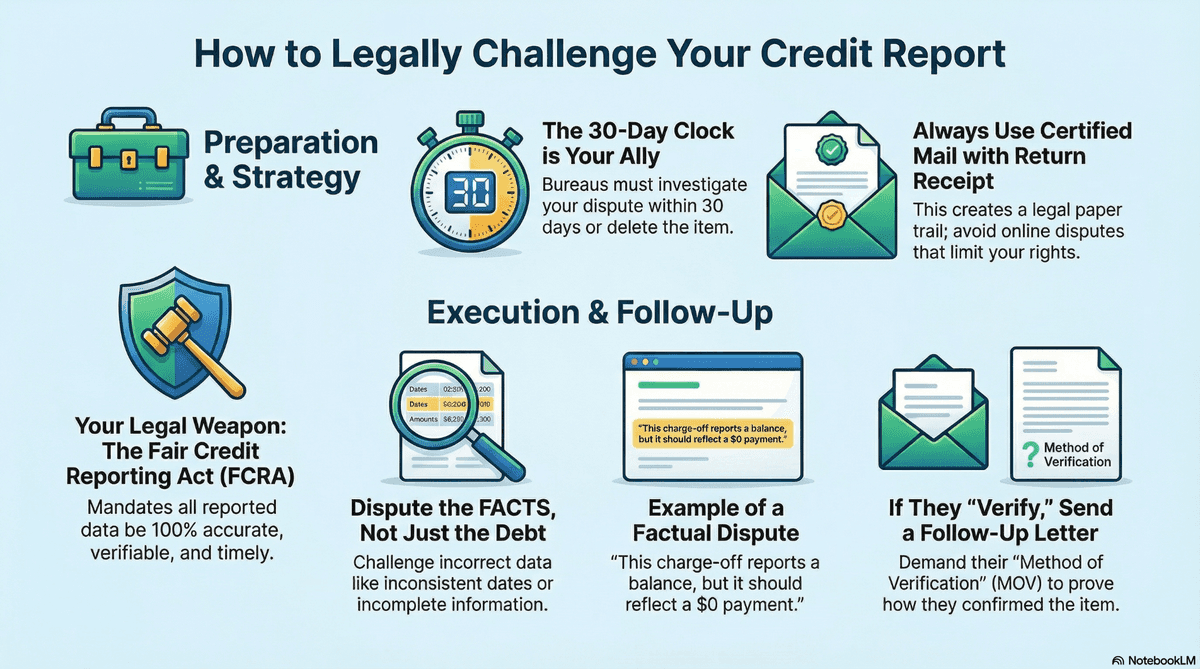
Use Facts, Not Feelings: The Factual Dispute Tactic
Don’t argue about whether you “owe” something in the abstract. Attack what’s printed.
- Inconsistent dates. Opened in October on one bureau, December on another? Can’t be both. That’s a factual mismatch.
- Charge-off math. “Charge-off” is an accounting event. After charge-off, you shouldn’t see a growing past-due amount as if the account’s still actively billing late fees the same way. If the numbers creep, note it.
- Missing fields. No “Date Opened”? No credit limit? No last update? Incomplete entries aren’t compliant entries.
- Status drift. One bureau shows “transferred/sold,” another keeps a balance on the original creditor? If it’s sold or transferred, the original reports $0. Period.
- Balance/limit contradictions. Utilization relies on the right limit. If one bureau omits the limit, utilization looks worse. That’s a fixable, factual error.
You’re building a list of precise defects, not writing a memoir. Quote the bad line, attach the page, circle the data, and say what must happen next.
“Verified”? Now You Ask
How
They Verified
The first “verified” letter isn’t the end. It’s the beginning.
Send a Method of Verification (MOV) demand by certified mail. You’re asking for the exact procedure used to confirm the data: who they contacted, what they reviewed, contact details for the furnisher, and how the investigation actually occurred. You’re not accepting a vague robot response. You’re demanding process details that either exist—or don’t.
Why this matters: many “investigations” boil down to an automated code exchange. If the bureau can’t adequately describe the method or furnish details that match your documents, you’ve created grounds for correction or deletion. And you’ve expanded your paper trail if you need to escalate.
Your Tools, Laid Out
- FCRA citations in plain English. No legal theater. Just the duty (accuracy, completeness, verifiability) and the remedy (correct or delete).
- FDCPA references when a debt collector’s reporting or behavior crosses the line.
- Certified Mail + Return Receipt. Every letter, every time. Keep copies of envelopes, USPS receipts, and green cards (or electronic confirmations).
- Clean exhibits. Highlighted report pages, account statements, screenshots with dates, and a simple index so a stranger can follow your file in five minutes.
Notice the theme? You’re removing excuses. If a bureau later claims they lacked information, your file shows otherwise—by date and tracking number.
How to Write Letters That Get Read
- Lead with the defect. “Equifax file shows Account #1234 opened 10/2022; Experian shows 12/2022. Both cannot be true.”
- Attach proof. Copies of the report pages from each bureau. Circle the lines. Label them “Exhibit A,” “Exhibit B.”
- State the duty. “Under the FCRA, information must be accurate and verifiable.”
- State the remedy. “Correct to the verified date or delete the item if it cannot be verified.”
- Start the clock. “This dispute was sent via Certified Mail on [date]; delivery confirmed on [date].”
- Stay brief. One page of body text. Exhibits do the heavy lifting.
Tone matters. You’re firm, not furious. Judges read calm letters better than rants, and so do compliance teams.
What To Do Instead of Clicking “Dispute”
- Draft targeted disputes that cite the factual errors you found—by line, not by vibe.
- Mail them certified with return receipt to each bureau reporting the item. Separate envelopes. Separate tracking numbers.
- Log everything in your tracker: dates sent, tracking numbers, delivered dates, promised deadlines, responses received.
- Calendar 35 days out. That gives mail time plus the investigation period. On day 35, either you have results or you escalate with an MOV or a follow-up dispute citing the missed or inadequate response.
This is calm pressure. Not noise.
Escalation Without Drama
If a bureau corrects part of the record but not all of it, say so—clearly—and resubmit the remaining defects with fresh exhibits. If a furnisher keeps feeding inconsistent data, send a direct dispute to the furnisher as well, again by certified mail, with the same exhibits and a short cover letter. Keep the circles tight: one issue per letter when possible. Cleaner issue, cleaner fix.
If you hit stonewalling—non-responses, vague boilerplate, or outcomes that ignore your evidence—your paper trail supports complaints to regulators or counsel. You built that trail on purpose.
Action Plan You Can Start Today
- Draft your letters. No free “templates” that scream form-letter. Use your facts, your exhibits, your dates. Cite the FCRA plainly.
- Go to the post office. Certified Mail with Return Receipt for each bureau and any furnisher involved. Keep the receipts. Photograph them. Save the PDFs.
- Update your tracker. Log delivery confirmations. Set the deadline reminder. File responses and mark what changed—line by line.
If there’s no adequate response by your deadline, send the MOV. If the MOV comes back thin, request deletion based on failure to properly verify and include the MOV exchange as an exhibit.
FAQs
Is it wrong to dispute something that’s technically mine?
You’re not debating ownership in the abstract. You’re demanding that whatever is reported is accurate, complete, and legally verifiable. If they can’t meet that standard, they don’t get to publish it.
How fast will I see movement?
Investigations generally run on a 30-day clock from receipt (sometimes up to 45 with added information). Updates often show within 45–60 days of your first mailing as bureaus refresh their files.
Do I need a credit repair company?
You can do this yourself. Many people get better results because they care more, document better, and won’t accept vague answers. If you do hire help, judge them by the quality of their letters and their record-keeping, not their slogans.
What if they just say “verified” again?
Send the Method of Verification letter. Ask for who, what, when, and how. If what comes back doesn’t line up with your documents—or doesn’t come back at all—you’ve got leverage to demand correction or deletion.
Should I still use online portals for speed?
Speed isn’t the problem. Proof is. Portals don’t give you the paper trail you need, and they can squeeze your dispute into a code that strips context. Certified mail keeps your words intact and your clock visible.
You’re not clicking buttons anymore. You’re building a case. Short letters. Sharp facts. Certified mail. Deadlines. And results that don’t hinge on a two-digit code.
0 comment(s) so far on Demand Credit Compliance — Don’t Ask For It