


Will a Jump Start Permanently Fix a Dead Nissan Battery?
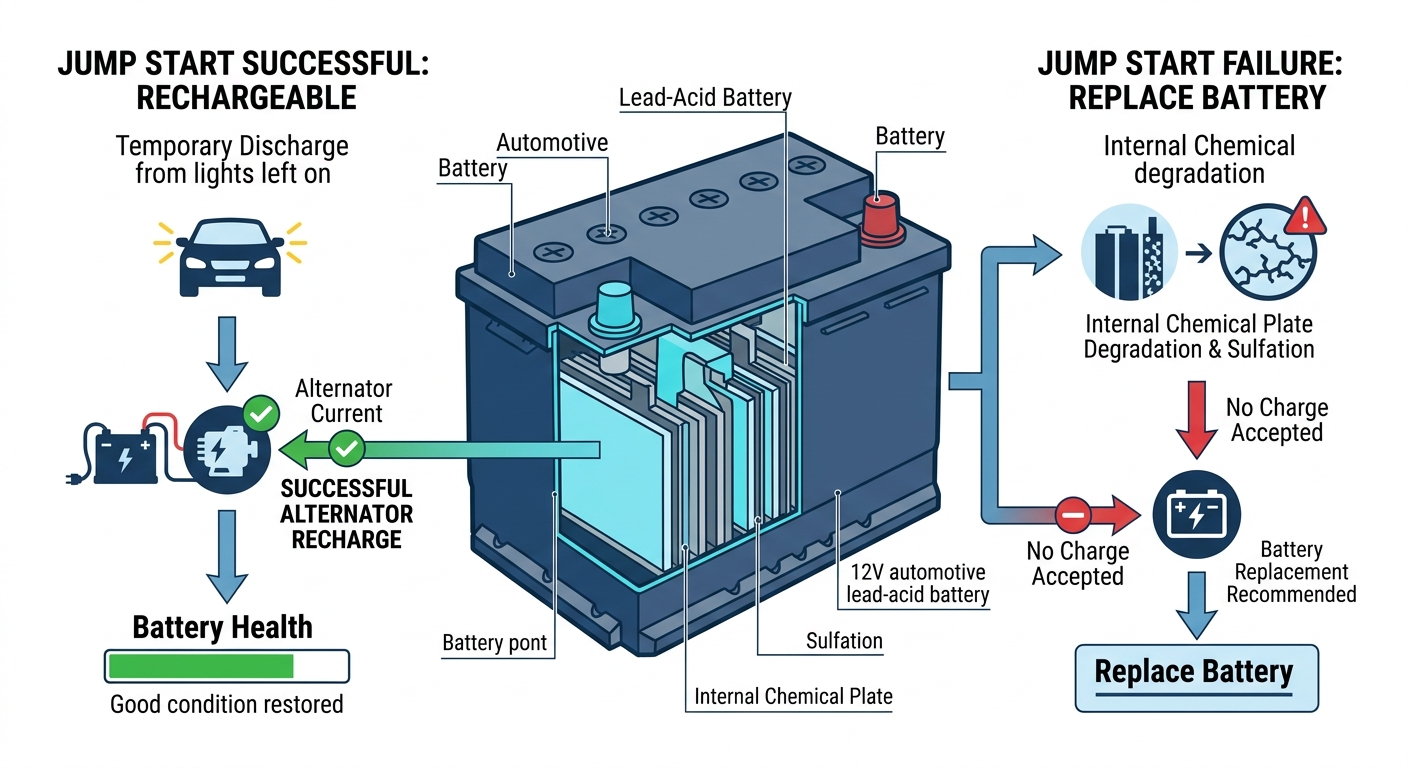
A jump start will not permanently fix a dead Nissan battery. Boosting a vehicle uses external electrical current from a booster battery or jump box to turn the engine over, allowing the alternator to take over and power running electronics. However, jump-starting cannot repair chemically degraded internal battery plates, resolve shorted internal cells, or restore lost reserve capacity. If your battery failed due to age, internal plate deterioration, or deep discharge, it will continue to lose charge and will likely leave you stranded again until it is replaced.
       [ Jump Start / External Booster ]
                       │
                       ▼
       [ Engine Starts / Alternator Runs ]
                       │
                       ▼
   Does the battery hold reserve capacity?
            ├── YES ──► Temporary Drain (e.g., Lights Left On)
            │           └─► Alternator recharges battery back to operational state
            │
            └── NO  ───► Chemical Degradation / Cell Failure
                        └─► Battery cannot retain charge ──► REPLACEMENT REQUIRED
When a battery goes completely flat, chemical changes occur within its lead-acid or AGM cells that permanently reduce its ability to store energy. While a working alternator will generate electrical power while the engine runs, it is designed to maintain a functional battery rather than recondition a worn-out unit. Driving for 30 minutes after a boost may temporarily supply enough power for one or two restarts, but an aged battery will quickly discharge below the voltage required to engage the starter solenoid.
Safe jump-starting procedures require strict adherence to factory guidelines. When jump-starting modern Nissan vehicles, always use a 12-volt booster supply and secure the cable clamps firmly. Connect the positive cable to the positive terminal of the discharged battery, but never attach the negative jumper lead directly to the negative terminal of the dead battery. Instead, clamp the negative lead to an unpainted engine or chassis ground point away from the battery to prevent sparking near combustible gases.
If your vehicle requires repeated jump starts or exhibits intermittent starting issues, schedule a comprehensive electrical system inspection at our Shelbyville service center or give our service department a quick call to verify your battery’s cranking amp output.
Table of Contents
- How Long Does a Nissan 12-Volt Battery Last and What Are the Signs of Failure?
- How Hot Weather Impacts Nissan Batteries and Why Proactive Replacement Matters
- What Does a Nissan Battery Replacement Cost and Is Genuine Warranty Included?
- Should You Install a Nissan Battery Yourself or Professional Service It?
- Common Questions About Nissan Battery Maintenance and Replacement
- Schedule Reliable Nissan Battery Testing and Replacement
How Long Does a Nissan 12-Volt Battery Last and What Are the Signs of Failure?
Most standard 12-volt Nissan batteries last between 3 and 5 years, though severe climate conditions and short-trip driving habits can reduce functional service life to approximately 2 years. Recognizing early symptoms of chemical degradation allows you to replace a failing unit before experiencing a complete starting breakdown.
Vehicle batteries rely on an internal chemical reaction to deliver heavy cold-cranking amps to the starter motor. Over time, active material sheds from the battery plates, decreasing overall storage capacity. When driving habits consist primarily of brief trips, such as local errands around Christiana, the alternator does not have sufficient time to fully restore the energy spent during engine startup. This continuous state of partial charge accelerates internal plate sulfation and shortens total battery lifespan.
Key Warning Signs of a Failing 12-Volt Battery
- Slow Engine Crank: The engine turns over sluggishly or takes significantly longer than normal to start when pushing the ignition button.
- Dimming Cabin and Exterior Lights: Dashboard displays, interior lights, or headlights appear unusually dim before the engine is running.
- Clicking Sounds at Ignition: Turning the key or pressing the start button produces a rapid clicking sound from the starter solenoid without turning the engine.
- Intermittent Keyless Entry Faults: The intelligent key system fails to unlock doors remotely or requires holding the fob against the start button.
- Dashboard Warning Indicators: The battery charge warning light or master warning indicator stays illuminated on the instrument cluster.
Modern Nissan vehicles place higher continuous demands on their electrical systems than older models. Advanced crossovers like the 2026 Nissan Rogue with its 1.5L engine utilize automatic engine stop-start technology, while larger three-row family vehicles like the 2026 Nissan Pathfinder powered by its 3.5L engine power extensive infotainment systems, driver-assist sensors, and power accessories. These advanced components depend on consistent voltage, making regular battery checks critical. If you are considering an upgrade to a newer vehicle with fresh factory components, explore our selection of new Nissan crossover models to see the latest technology in action.
Fuel Economy
Fuel economy and range by trim
| Feature | 2.5 SR | 2.5 SR AWD | 2.5 SV | 2.5 SV AWD |
|---|---|---|---|---|
| MPG | 26 city / 36 hwy / 30 combined | 25 city / 33 hwy / 28 combined | 26 city / 36 hwy / 30 combined | 25 city / 33 hwy / 28 combined |
How Hot Weather Impacts Nissan Batteries and Why Proactive Replacement Matters
Elevated summer temperatures accelerate internal grid corrosion and cause liquid electrolyte evaporation within 12-volt battery cells, making hot weather more damaging to overall battery health than extreme cold. Proactive battery replacement before total failure prevents unexpected strandings and protects sensitive vehicle electronics from low-voltage spikes.
While drivers frequently associate battery failure with winter freezes, high ambient temperatures are the primary root cause of internal battery damage. Extreme heat speeds up the internal chemical reactions inside lead-acid batteries, leading to plate degradation and water loss from the electrolyte solution. Once internal corrosion takes hold during hot summer months, the weakened battery struggles to provide sufficient cold-cranking power when autumn or winter temperatures drop, causing sudden no-start conditions.
For drivers navigating the rolling hills and countryside around Royal, a sudden battery breakdown can mean waiting for assistance far from immediate service facilities. Proactively replacing a battery after 3 to 4 years of operation provides essential peace of mind. Replacing an aging battery on your own schedule eliminates the frustration of morning starting failures, unexpected towing bills, and disrupted daily routines.
Regular battery voltage testing during routine maintenance intervals provides clear visibility into your battery’s remaining reserve capacity. Our factory-trained technicians measure both static voltage and cold-cranking performance, identifying weak cells before they collapse entirely. If you are evaluating ownership costs across your household vehicles, check out our available pre-owned vehicle offers for exceptional value on reliable transportation.
What Does a Nissan Battery Replacement Cost and Is Genuine Warranty Included?
A standard genuine Nissan 12-volt battery replacement typically costs between $150 and $300 for the unit, with professional installation labor generally adding $50 to $100 depending on vehicle configuration. Genuine Nissan replacement batteries come backed by an 84-month limited warranty when installed by an authorized dealership service center.
Replacement costs vary based on whether your vehicle uses a standard flooded lead-acid battery or an Absorbed Glass Mat (AGM) battery required for models equipped with automatic stop-start technology. AGM units feature higher reserve capacity and rapid-recharge acceptance, making their production costs slightly higher than conventional batteries. However, investing in the correct battery specification ensures proper electrical system performance and long-term durability.
Every vehicle lineup presents specific electrical demands. For example, sedan platforms require precise battery tray sizing and terminal orientations. The 2026 Nissan Altima lineup includes versatile trim grades such as the 2.5 SV with a base MSRP of $27,580, the 2.5 SV AWD at $29,080, the sport-focused 2.5 SR at $28,980, and the 2.5 SR AWD at $30,480, each subject to a $1,245 destination charge. Matching the exact factory battery specification for your specific model grade preserves voltage stability across all onboard electronics.
Benefits of Genuine Nissan Batteries
- Engineered to OE Specifications: Formulated specifically to match the original electrical load, terminal type, and hold-down dimensions of your vehicle.
- 84-Month Limited Warranty Protection: Includes a pro-rated replacement credit policy that protects your investment for up to seven years.
- Factory-Trained Installation: Fitted by certified technicians who clean terminal posts, apply anti-corrosion protection, and ensure proper cable clamping.
Drivers interested in comprehensive vehicle coverage can review our certified pre-owned inventory guarantees to see how factory warranties protect major vehicle components. If you prefer to manage minor repairs yourself or require exact factory components, contact our original OEM parts department to order the exact replacement battery for your year and trim. You can also easily value your trade-in online if you are planning to transition into a new vehicle.
Pricing
Pricing by trim
| Feature | 2.5 SR | 2.5 SR AWD | 2.5 SV | 2.5 SV AWD |
|---|---|---|---|---|
| Base MSRP | $28,980 | $30,480 | $27,580 | $29,080 |
| Destination charge | $1,245 | $1,245 | $1,245 | $1,245 |
Should You Install a Nissan Battery Yourself or Professional Service It?
While replacing a vehicle battery at home appears straightforward, professional installation ensures correct electrical system registration, safety compliance, and protection for sensitive onboard computers. Modern Nissan vehicles feature complex electronic control networks that require uninterrupted voltage or recalibration during service.
Installing a battery independently carries subtle technical risks. When power is completely disconnected without a memory saver, control modules can lose stored drive-cycle parameters, window auto-up settings, and radio presets. Furthermore, on vehicles equipped with supplemental restraint systems (SRS), official factory service procedures mandate disconnecting the negative 12-volt battery terminal and waiting at least 3 minutes before servicing nearby electronic control components. This waiting period allows stored electrical energy in backup power capacitors to discharge safely.
**12-VOLT BATTERY DIAGNOSTIC VOLTAGE RANGES**

| State / Condition | Voltage Reference Range |
| --- | --- |
| Vehicle Off (Engine / EV Off) | 12.4 V - 12.8 V  (Fully Charged) |
| Charging / Running State | 13.5 V - 14.0 V  (Alternator Active) |
| Low Charge Warning Threshold | Below 12.0 V     (Service Needed) |
Professional diagnostic equipment verifies charging system health beyond simple physical replacement. Certified technicians perform conductance testing to evaluate internal resistance and measure operating voltage. On modern vehicles and electric models like the Ariya, healthy 12-volt battery baseline readings measure approximately 12.4 V to 12.8 V with the system powered down, and 13.5 V to 14.0 V while the charging system is active.
Choosing certified dealership maintenance guarantees proper core disposal, terminal corrosion treatment, and factory-backed labor. Reserve your appointment through our online battery service reservation portal, and take advantage of our flexible service financing options to spread maintenance costs comfortably over time.
Common Questions About Nissan Battery Maintenance and Replacement
Q: How long can a Nissan vehicle sit without being driven before the battery dies?
A healthy 12-volt battery can typically maintain sufficient charge to start an unused vehicle for 2 to 4 weeks. However, continuous parasitic drain from keyless entry receivers, security alarms, and internal clock modules gradually depletes battery energy over time. If a vehicle must remain parked for over a month, connecting an automatic trickle charger or floating battery tender is recommended to prevent deep discharge.
Q: Does an electric vehicle like the Nissan LEAF still have a 12-volt battery?
Yes, electric vehicles like the Nissan LEAF and Ariya utilize a standard 12-volt auxiliary battery alongside their high-voltage lithium-ion traction battery. The 12-volt battery powers essential low-voltage systems, including exterior headlights, door locks, infotainment screens, cabin displays, and safety contactor relays required to energize the main high-voltage system.
Q: What warranty covers the high-voltage battery on a Nissan electric vehicle?
Nissan Electric Vehicles feature dedicated high-voltage lithium-ion battery warranty coverage for up to 8 years/100,000 miles. This limited warranty protects against capacity loss below the operational threshold indicated on the vehicle battery capacity gauge, ensuring long-term confidence in electric drivetrain performance.
Q: Can a failing 12-volt battery cause false dashboard error codes?
Low system voltage caused by a dying 12-volt battery frequently triggers false error codes across multiple electronic control units. When system voltage drops below operational thresholds during engine cranking, sensitive sensors may report computer communication faults or illuminate warning lamps even when mechanical hardware is completely functional.
Q: Why do vehicles with engine stop-start systems require specific battery types?
Vehicles equipped with automatic engine stop-start systems require Enhanced Flooded Batteries (EFB) or Absorbed Glass Mat (AGM) units designed for frequent discharge and rapid recharge cycles. Installing a standard lead-acid battery in a stop-start vehicle leads to premature battery failure within months due to the rapid electrical demands of repeated engine restarts.
During routine vehicle visits, our technicians inspect multiple safety systems beyond electrical health. Read our guide on tire safety and tread depth to keep your vehicle balanced, or explore the rugged durability of the Nissan Frontier to learn about our capable truck lineup.
Schedule Reliable Nissan Battery Testing and Replacement
Maintaining a fresh 12-volt battery is essential for smooth daily starting and consistent electronic performance. While a quick jump start can help you navigate an immediate emergency, resolving underlying battery degradation requires professional testing and timely replacement.
Our factory-certified service center is equipped with advanced diagnostic tools to test cranking capacity, check alternator output, and install genuine original equipment batteries backed by an 84-month limited warranty. Whether you require routine battery testing or complete electrical troubleshooting, our dedicated service team delivers fast, reliable care tailored to your vehicle’s exact specifications.
Visit us at 2801 US-231 in Shelbyville or drop a pin for our convenient location on US-231 to get your vehicle serviced. You can also contact our service advisors directly at (931) 536-3118 to reserve your next maintenance appointment.
0 comment(s) so far on Will a Jump Start Permanently Fix a Dead Nissan Battery?