

Why Your Brake Fluid is the Critical Link to Safe Stopping
Why Your Brake Fluid is the Critical Link to Safe Stopping
Let me tell you what I have learned from my years in the service department: most drivers think about their brakes only when they hear a squeal or feel a vibration. While brake pads and rotors are vital, the hydraulic fluid is what actually translates the pressure from your foot into stopping force at the wheels. If that fluid is compromised, your braking system cannot operate at peak performance, regardless of how new your pads are. This is especially true for families in Christiana who rely on their vehicles for daily school runs and highway commutes where consistent pedal response is a safety requirement.
In my experience, the most common oversight is treating this fluid like it is “sealed” for life. In reality, brake fluid is hygroscopic, meaning it actively absorbs moisture from the air over time. This moisture lowers the boiling point of the fluid, which can lead to brake fade during heavy use or when navigating the rolling terrain of Middle Tennessee. To ensure your vehicle remains reliable, we recommend that you schedule maintenance online to have your fluid levels and clarity inspected by a professional.
If you are noticing a change in how your vehicle responds, it might be time to schedule brake service for a thorough evaluation. We often see moisture accumulation lead to internal corrosion in the master cylinder and ABS valves, which are much more expensive to repair than a standard fluid exchange. If you have any concerns about your vehicle’s safety systems or want to check for vehicle recalls, our team is here to provide the technical expertise you need. For those who prefer a direct conversation, feel free to give us (931) 536-3118 to discuss your specific maintenance schedule.
What is the Primary Purpose of a Brake Fluid Exchange
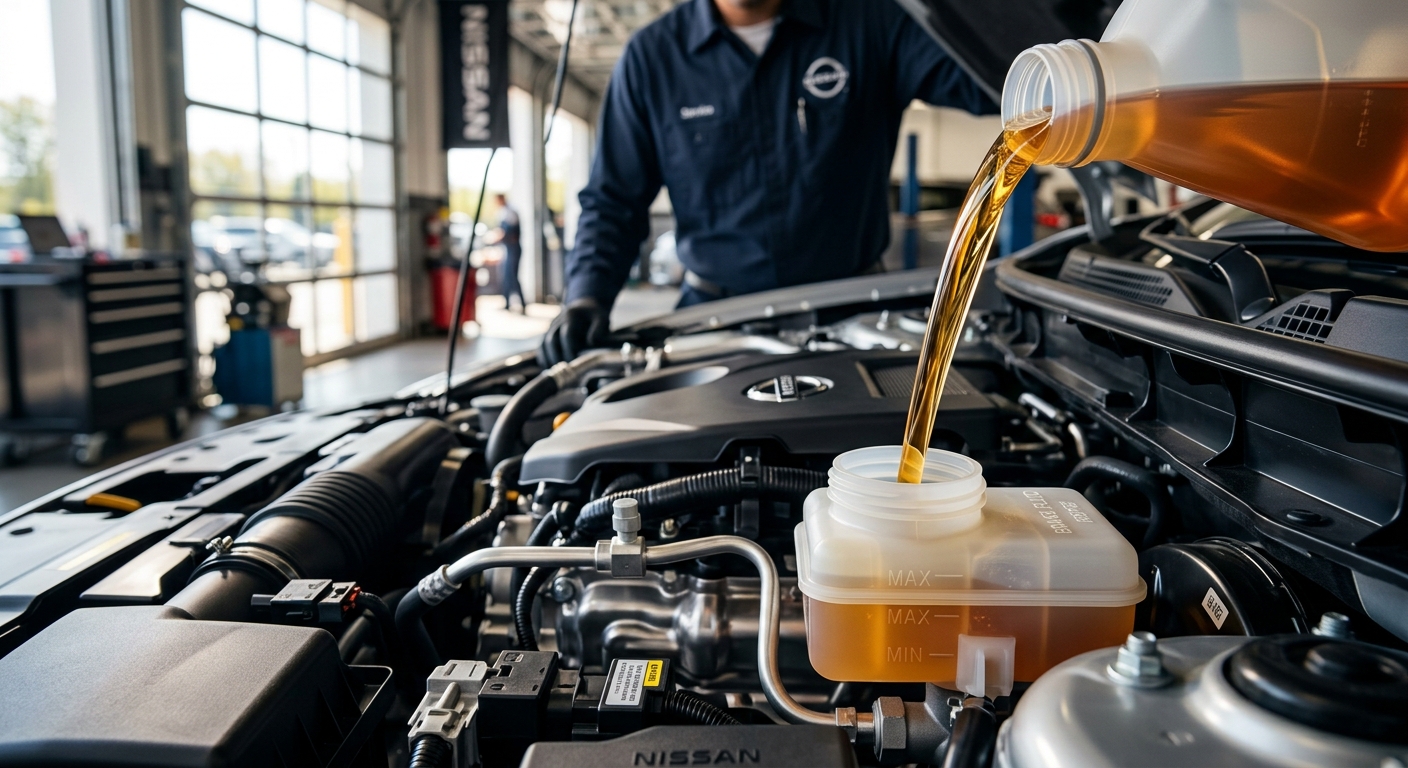
Many of our customers ask why we recommend an exchange instead of just “topping off” the reservoir. The primary purpose of a brake fluid exchange is to remove old, contaminated fluid and replace it with fresh, 100% clean solution to maintain hydraulic pressure and prevent internal component failure. When you drive a vehicle like the 2026 Nissan Rogue, which features advanced safety tech like Automatic Emergency Braking, the system depends on the fluid being incompressible. If moisture or air bubbles enter the lines, the fluid becomes compressible, leading to a dangerous delay in stopping time.
We see this most often with high-mileage vehicles or those used for heavy hauling. For instance, a 2026 Nissan Pathfinder with its 3.5L V6 engine is built for family adventures, but that extra weight puts more heat into the braking system. Fresh fluid handles this heat without boiling, ensuring that your 5 years / 60,000 miles powertrain warranty protection is backed by a vehicle that actually stops when you need it to. If you are considering an upgrade to a vehicle with these capabilities, you can explore pre-owned vehicle specials to find a model that fits your budget and safety needs.
The 2026 Nissan Rogue lineup offers a variety of trims, from the entry-level S starting at $31,610 to the premium Platinum at $42,894. Each of these models, including the rugged Rock Creek edition priced at $37,113, utilizes a sophisticated CVT and hydraulic braking setup that requires clean fluid to function correctly. Whether you are interested in new Nissan cars for a more efficient commute or need the utility found in our new Nissan Frontier inventory, keeping the hydraulic system clean is the best way to protect your investment and your passengers.
Table of Contents
- Recognizing the Warning Signs of Contaminated Brake Fluid
- The Technical Difference Between a Quick Bleed and a Full Exchange
- Proactive Maintenance to Keep Your Stopping Power Secure
Recognizing the Warning Signs of Contaminated Brake Fluid
I often hear drivers describe their brake pedal as feeling “spongy” or “soft,” which is a classic indicator that the fluid has reached its limit. When brake fluid is fresh, it should be clear or light amber in color. If you pop the hood and see fluid that looks dark brown or black, that is a clear sign of heavy contamination and oxidation. This typically happens every 2 to 3 years, though the heavy humidity we sometimes experience in Middle Tennessee can accelerate the process.
Pricing
MSRP and destination charges (source: MarketCheck VIN Decode (consensus))
| Feature | S | SV | Rock Creek | Dark Armor | Platinum | SL |
|---|---|---|---|---|---|---|
| Starting MSRP | $31,610 | $33,806 | $37,113 | $37,171 | $42,894 | $48,485 |
Lowest starting MSRP: S at $31,610
If you are out near Union Grove and notice that your vehicle requires a longer stopping distance than usual, do not ignore it. This often happens because contaminated fluid has a lower boiling point, creating gas bubbles in the lines that do not transfer pressure effectively. You might also see a brake warning light illuminate on your dashboard. When these signs appear, it is worth looking through our current new vehicle inventory to see the latest safety features available, or specifically browse new Nissan SUVs if you need a vehicle with more robust four-wheel disc brakes.
For those driving smaller, agile models, the 2026 Nissan Kicks is a great example of a vehicle where crisp braking response is part of the driving experience. You can shop new Nissan Kicks inventory to see how modern engineering prioritizes driver feedback. However, even the most advanced Lane Keeping Assist or Blind Spot Monitor cannot compensate for a hydraulic system filled with murky, moisture-laden fluid. Checking the reservoir is a simple way to stay ahead of these issues before they turn into a mid-drive emergency.
The Technical Difference Between a Quick Bleed and a Full Exchange
Working with precision machinery requires understanding the difference between a “bleeding” service and a “full exchange.” A brake bleed is typically done to remove air bubbles after a mechanical repair, like replacing a caliper. A brake fluid exchange, or flush, involves a professional-grade machine that pushes all the old fluid out of the entire system—including the ABS modulator and the furthest reaches of the brake lines—and replaces it with 100% fresh fluid. This ensures that no pockets of moisture or debris remain to cause internal corrosion.
Safety & Driver Assistance
Safety ratings and driver assistance systems
| Feature | S | SV | Rock Creek | Dark Armor | Platinum | SL |
|---|---|---|---|---|---|---|
| IIHS Rating | TOP SAFETY PICK | TOP SAFETY PICK | TOP SAFETY PICK | TOP SAFETY PICK | TOP SAFETY PICK | TOP SAFETY PICK |
Standard across all trims:
| Feature | Included |
|---|---|
| Forward Collision Warning | ✓ |
| Automatic Emergency Braking | ✓ |
| Lane Departure Warning | ✓ |
| Lane Keeping Assist | ✓ |
| Blind Spot Monitor | ✓ |
| Rear Cross-Traffic Alert | ✓ |
| Blind Spot Intervention | ✓ |
This level of detail is especially important for modern vehicles like the 2026 Nissan Altima, which uses a 2.5L I4 engine and 4WD on several trims. The SV trim, starting at $31,008, relies on a complex network of sensors and valves to manage traction and braking simultaneously. You can shop new Nissan Altima inventory to see how these systems integrate. If the fluid is not fully exchanged, old contaminants can settle in the ABS valves, leading to a much more expensive repair down the road.
We also see unique requirements for our electric vehicles. If you shop new Nissan electric vehicles, you will find that models like the LEAF use regenerative braking. While this reduces wear on your brake pads, the hydraulic fluid still ages and absorbs moisture just like any other car. If you shop new Nissan LEAF inventory, remember that the 3 years / 36,000 miles basic warranty covers the vehicle, but proactive fluid maintenance is what keeps the mechanical backup system ready for action during an emergency stop.
Proactive Maintenance to Keep Your Stopping Power Secure
One of the first things I tell my customers is that preventative maintenance is always cheaper than emergency repair. By following the recommended interval of an exchange every 24,000 miles or two years, you are essentially buying insurance for your master cylinder and brake lines. This is particularly vital for those who use their vehicles for work or heavy commuting. For example, the 2026 Nissan Rogue features a 1.5L I3 engine paired with a CVT, designed for efficiency. Keeping the brakes in top shape ensures that the 30 city / 37 hwy mpg rating is matched by a vehicle that handles safely in stop-and-go traffic.
The 2026 Nissan Rogue is available in several configurations, including the SV with FWD and the Rock Creek with 4WD. Each utilizes the same fundamental hydraulic principles, meaning they all benefit from regular fluid inspections. If you need a larger vehicle for towing or larger groups, you might shop new Nissan Armada inventory to find a V8 powered SUV that demands even more from its braking system. No matter which model you drive, our team is ready to help you maintain it. You can find our Shelbyville dealership easily for your next service visit.
If you have questions about your specific maintenance schedule or want to know more about how we perform a fluid exchange, please reach out. You can give us a quick call to speak with a service advisor directly. We take pride in helping our neighbors keep their vehicles on the road longer and safer. Whether you are heading out for a weekend at the lake or just commuting to work, knowing your braking system is filled with fresh, high-quality fluid provides the peace of mind you deserve.
0 comment(s) so far on Why Your Brake Fluid is the Critical Link to Safe Stopping