

Why Brake Fluid Exchanges Keep Drivers Safe on the Road
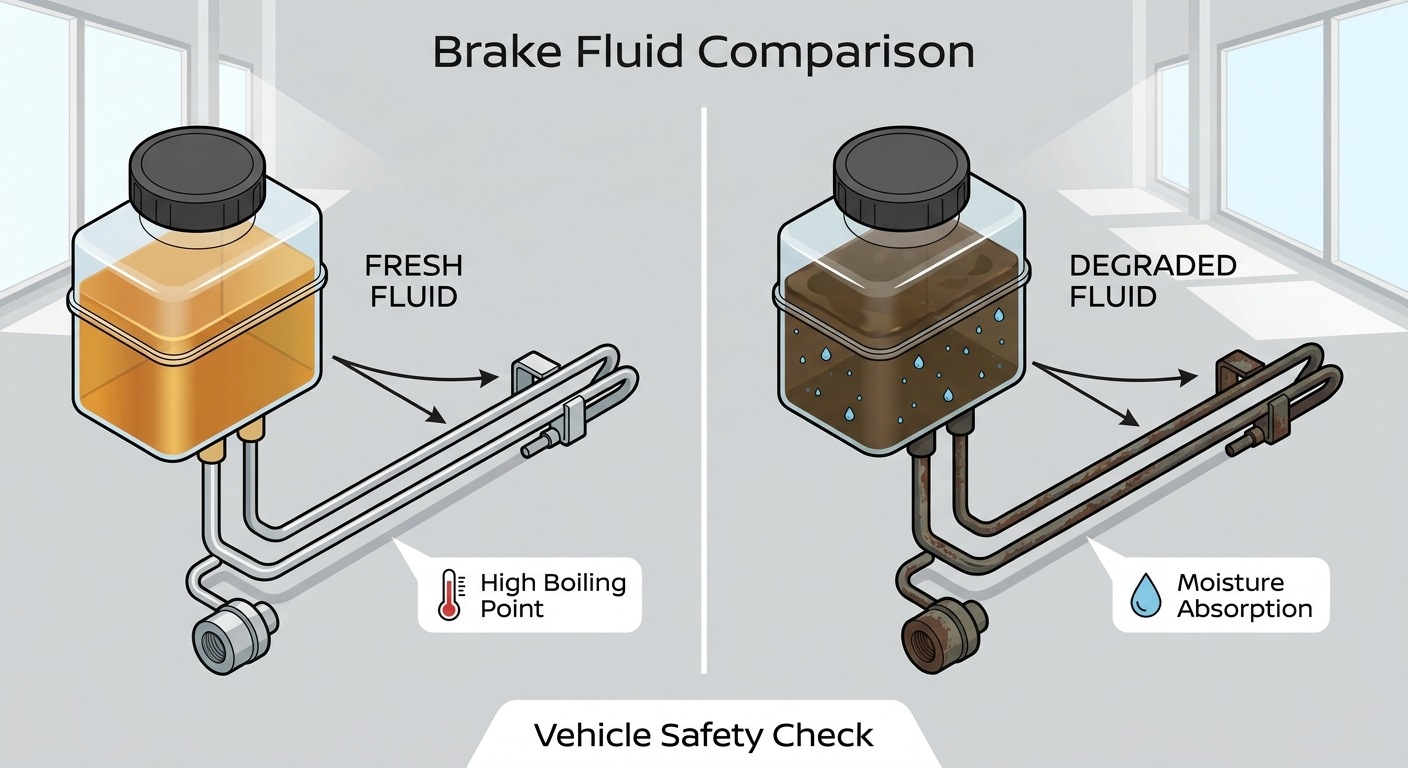
Your vehicle’s braking system relies on hydraulic pressure to convert the physical press of your foot into the massive clamping force needed to halt thousands of pounds of steel. At the center of this network is brake fluid, a specialized liquid designed to operate under intense heat and pressure. Maintaining this fluid is not a secondary concern; it is a critical safety requirement. Over time, the chemical composition of this fluid degrades, directly impacting your stopping distance and pedal feel.
Most automotive manufacturers specify brake fluid changes as critical maintenance rather than an optional service. A typical industry standard is to replace glycol-based DOT 3 or DOT 4 brake fluid every 2 to 3 years, or roughly every 24,000 to 45,000 miles. Because moisture absorption occurs constantly, time is actually a more critical factor than mileage. Even if your vehicle sits in a garage or is only used for short trips, the fluid is actively drawing in moisture from the surrounding atmosphere.
When you ignore this service window, you risk experiencing brake fade during hard stops or when driving down steep grades. Fresh fluid ensures that the boiling point remains high and hydraulic pressure stays consistent, allowing your vehicle to stop exactly as the engineers intended. If you are noticing a soft pedal or want to verify your system’s health, you can schedule brake service with our factory-trained technicians. We can also handle other vital safety items during your visit, such as helping you shop for new tires or explaining the importance of tire alignment for your vehicle’s handling.
For those who prefer to check their vehicles before booking an appointment, we recommend looking up your check for vehicle recalls status or using our schedule maintenance online tool. If you need to speak with a specialist directly, you can reach out to contact our service team or give us a call at (931) 536-3118. For complete maintenance, our team is also ready to schedule battery service, help you replace your key fob, or get you set up with a convenient schedule your Nissan service slot.
Table of Contents
- What Happens to Hydraulic Systems When You Never Change Brake Fluid
- What Tools Do I Need for a DIY Brake Fluid Exchange
- The Step-by-Step Reality and Risks of Bleeding Your Own Brakes
- How Technicians Diagnose Contaminated Fluid and Verify System Health
- Recommended Maintenance Intervals for Commuters and Rural Drivers
- Common Questions About Hydraulic Brake Maintenance and DIY Tooling
- Schedule Professional Brake Service
What Happens to Hydraulic Systems When You Never Change Brake Fluid
Glycol-based brake fluids are hygroscopic, meaning they act like a sponge, naturally absorbing water from the air. Under normal driving conditions, this absorption occurs at a typical rate of about 2% to 3% per year. This process accelerates significantly in warm, high-humidity environments. As the water content within the hydraulic lines rises, the physical properties of the fluid undergo a dangerous transformation.
The primary danger of moisture contamination is the drastic lowering of the fluid’s boiling point. Under heavy braking, the friction between your brake pads and rotors generates extreme thermal energy. If the fluid contains water, that water can vaporize into steam bubbles inside the lines. Because gas is compressible—unlike liquid—pressing the pedal simply compresses the steam bubbles instead of moving the brake calipers. This results in a spongy, sinking pedal, a dramatic reduction in hydraulic pressure, and dangerously long stopping distances.
Over time, this moisture also reacts with the metal internal components of your braking system. The water oxidizes steel and aluminum, leading to internal corrosion that sheds microscopic debris. This debris can clog the delicate micro-valves inside your Anti-lock Braking System (ABS) and electronic stability control actuators. Replacing an ABS modulator is a highly complex, expensive repair that can easily be avoided with regular fluid exchanges.
If you are driving an older vehicle or a high-mileage model, keeping up with these fluid flushes is even more critical to prevent component failure. For those looking to upgrade to a vehicle with a fully inspected, fresh braking system, you can browse our pre-owned vehicle specials to find a reliable car. Families looking for larger, modern safety suites can explore our spacious browse new Nissan SUVs. To keep track of your vehicle’s service history and receive maintenance reminders directly on your phone, be sure to download our mobile app.
What Tools Do I Need for a DIY Brake Fluid Exchange
If you plan to perform a brake fluid exchange in your own garage, having the correct equipment is essential for both safety and system performance. Working on a hydraulic system requires precision; using the wrong tool can round off bleeder screws or introduce air into the lines.
To complete a clean, successful DIY brake fluid exchange, you will need the following tools:
- A High-Quality Jack and Heavy-Duty Jack Stands: You must raise the vehicle and remove all four wheels to access the bleeder valves on the calipers or wheel cylinders. Never work under a vehicle supported only by a hydraulic jack.
- A Brake Bleeder Kit or Vacuum/Pressure Bleeder: A manual vacuum pump or a pressurized brake bleeder bottle makes the job much easier. A pressure bleeder attaches to the master cylinder reservoir and pushes fresh fluid through the lines, allowing a single person to complete the job without needing an assistant to pump the brake pedal.
- Line Wrenches (Flare Nut Wrenches): Standard open-ended wrenches can easily slip and strip the soft metal bleeder screws. A dedicated flare nut wrench (typically 8mm, 10mm, or 11mm depending on your vehicle) grips the screw on five sides to prevent damage.
- Clear, Flexible Vinyl Tubing and a Catch Bottle: You will need tubing that fits snugly over the bleeder nipple. The clear tubing allows you to watch the fluid color change from dark brown to clear and observe when air bubbles stop exiting the line.
- Fresh, Sealed Brake Fluid: Always use the exact fluid type specified on your reservoir cap or in your owner’s manual—typically DOT 3 or DOT 4. Never use fluid from a bottle that has been open for more than a few weeks, as it has already absorbed moisture from the air.
- Nitrile Gloves and Safety Glasses: Brake fluid is highly corrosive to your skin and will instantly strip automotive paint if spilled. Keep plenty of shop towels and a can of brake cleaner nearby to clean up drips immediately.
For drivers who prefer the peace of mind that comes with professional calibration, upgrading to a modern vehicle with advanced safety systems is a popular route. You can browse new inventory to see the latest models equipped with advanced braking assist technologies. If you are looking for a refined, comfortable cruiser, you can shop new Nissan Murano inventory. For those interested in cutting-edge regenerative braking systems that require specialized service procedures, you can shop new Nissan electric vehicles to find an efficient alternative.
The Step-by-Step Reality and Risks of Bleeding Your Own Brakes
While a DIY brake fluid exchange is highly satisfying, it carries real operational risks. The basic process involves placing the vehicle on level ground, locating the master cylinder, and removing the old, dark fluid from the reservoir with a syringe or turkey baster. From there, you fill the reservoir with clean fluid and proceed to bleed each wheel, starting at the point furthest from the master cylinder—typically the passenger-side rear wheel—and working your way forward.
The primary risk during a manual two-person bleed is letting the master cylinder reservoir run dry. If the fluid level drops too low while you are pumping the pedal, air will be sucked directly into the piston assembly. Once air enters the master cylinder, it often cannot be removed by simple bleeding at the wheels; you may have to remove the entire unit to bench-bleed it, or use a professional scan tool to cycle the ABS solenoids to purge the trapped air.
Additionally, rusted bleeder screws present a major obstacle. In areas with high humidity or road salt, these small metal valves can seize completely. Applying too much torque with a standard wrench can snap the bleeder screw off flush with the caliper body, instantly turning a simple fluid exchange into an expensive caliper replacement.
If you find yourself facing seized components or a soft pedal after a DIY attempt, our professional service bay is fully equipped to resolve the issue. If you are looking for a highly reliable commuter car that is easy to maintain, you can shop new Nissan Altima inventory. Drivers who need a rugged truck capable of handling heavy payloads and demanding stopping situations can shop new Nissan Frontier inventory. For performance enthusiasts who demand absolute precision from their multi-piston sport brakes, we invite you to shop new Nissan Z inventory.
How Technicians Diagnose Contaminated Fluid and Verify System Health
Professional automotive technicians do not rely on guesswork or simple visual checks to determine when your brake fluid needs to be replaced. While dark brown or cloudy fluid is a clear indicator of heavy oxidation and contamination, clear fluid can still contain dangerous levels of dissolved water. To get an accurate reading, technicians utilize specialized diagnostic equipment.
One primary tool is the electronic boiling point tester. This device heats a small sample of fluid drawn from your reservoir until it boils, measuring the exact temperature at which vaporization occurs. If the boiling point falls below the minimum safety threshold established by the Department of Transportation, the fluid is flagged for immediate replacement. Technicians also use chemical copper test strips. As brake fluid ages, its anti-corrosive additives deplete, allowing copper to leach from the inner lining of the brake lines into the fluid. The test strip changes color to indicate the parts-per-million of copper, revealing how much internal wear is occurring.
During a professional multi-point inspection, technicians also inspect the physical brake pads, rotors, and rubber flexible hoses for signs of weeping or cracking. This comprehensive approach ensures that your entire stopping system is operating at peak performance.
If you are looking for an adventurous family vehicle that benefits from regular, professional multi-point health checks, you can shop new Nissan Pathfinder inventory. For those who need a full-size, heavy-duty SUV built to handle heavy family hauling, you can shop new Nissan Armada inventory. If you prefer a compact, nimble crossover that is perfect for navigating tight parking spaces, you can shop new Nissan Kicks inventory.
Recommended Maintenance Intervals for Commuters and Rural Drivers
Your daily driving habits and geographic location play a major role in how quickly your brake fluid degrades. While a standard baseline of 2 to 3 years is recommended for typical driving, vehicles operated in demanding environments require closer attention.
For instance, families living in Christiana often experience a mix of gently rolling farmland driving and highway commuting on Interstate 24. Commuting to nearby cities means frequent high-speed stops, which generate significant thermal energy in the braking system. Under these conditions, checking your brake fluid level and clarity at least once a year is a smart preventive measure.
For drivers navigating the hilly terrain around Royal, the demands on your brakes are even more pronounced. Driving down steep hills and winding country roads requires sustained brake application, which heats the calipers and can cause moisture-laden fluid to boil much faster than it would during flat highway driving. If you frequently drive in these hilly areas, sticking to a strict 2-year flush interval is highly recommended to prevent brake fade.
Whether you are looking for an efficient commuter vehicle or a practical daily driver, we have options to fit your lifestyle. You can shop new Nissan cars to find a fuel-efficient sedan, or check out our shop new Nissan Kicks Play inventory for a youthful, tech-forward crossover. If you are ready to transition to an all-electric platform with advanced regenerative stopping systems, you can shop new Nissan LEAF inventory.
Common Questions About Hydraulic Brake Maintenance and DIY Tooling
Understanding the technical details of your braking system helps you make informed decisions about your vehicle’s upkeep. Many owners wonder if they can mix different types of brake fluid if the reservoir is low. The answer is generally no; while DOT 3 and DOT 4 are both glycol-based and can technically mix in an emergency, DOT 4 has a higher boiling point and mixing them lowers the overall thermal capacity of your system. Furthermore, never mix glycol-based fluids with silicone-based DOT 5 fluid, as they will react and turn into a gel that can destroy your entire hydraulic system.
Another common question is whether electric and hybrid vehicles require fluid exchanges. Even though these vehicles utilize regenerative braking to slow down using the electric motor, they still feature standard hydraulic calipers for emergency stops and low-speed braking. Because the physical brakes are used less frequently, they can actually accumulate moisture and rust faster, making regular fluid inspections critical.
If you are interested in transitioning to an electric platform, you can learn about electric vehicles or read our guide to learn about Nissan EVs. At Newton Nissan South, we love supporting our local community and sharing our automotive knowledge. You can learn more about our dealership, explore our community roots by reading about the Lynchburg music festival, or read our resource on learn about tire safety.
We also offer specialized resources to help you find the right vehicle, such as our guides to learn about Frontier quality and learn about Rogue quality. Additionally, we are proud to support those who serve, and you can check out our dedicated programs to learn about military discounts. To learn more about our customer-first philosophy, take a moment to learn about the Newton Advantage or find out how we support drivers across Tennessee by reading our learn about our dealership overview.
Q: Can I use a turkey baster to change my brake fluid?
An old turkey baster is a great tool for removing old, dirty fluid from the master cylinder reservoir before you begin bleeding. However, this only replaces the fluid in the plastic reservoir, leaving all the dirty, moisture-filled fluid inside the steel lines and calipers. To perform a true exchange, you must push fresh fluid through the entire system until it exits clean at all four wheels.
Q: How do I know if my brake fluid is DOT 3 or DOT 4?
The correct fluid specification is almost always stamped directly onto the plastic cap of your master cylinder reservoir. If the writing has worn off, you can find the exact requirement in the technical specifications section of your vehicle’s owner’s manual.
Q: What does contaminated brake fluid look like?
Fresh brake fluid is nearly clear with a light yellow or amber tint. As it absorbs moisture and accumulates microscopic metal debris, it darkens to a deep gold, then brown, and eventually looks like dark iced tea or black coffee. If the fluid in your reservoir is dark or cloudy, it needs to be exchanged immediately.
Q: Why does my brake pedal feel spongy after bleeding my brakes?
A spongy pedal after a fluid change is a classic symptom of air trapped inside the hydraulic lines. Because air bubbles compress under pressure, they absorb the force that should be going to the brake calipers. You will need to bleed the system again, ensuring no air enters the master cylinder, to restore a firm pedal.
Schedule Professional Brake Service
While performing a DIY brake fluid exchange is a great weekend project for experienced home mechanics, the braking system is your vehicle’s most critical safety feature. Any mistake—such as stripping a bleeder screw, letting air enter the ABS module, or using the wrong fluid—can immediately compromise your stopping power.
At Newton Nissan South, our factory-trained technicians use professional-grade flush machines that exchange your fluid under precise pressure, ensuring no air enters the system. We also dispose of the old, toxic fluid safely and inspect your entire braking system from the pedal to the pads.
Before you schedule your appointment, you can browse our view current service specials to find great savings on routine maintenance, or read through our helpful read service and parts tips for more DIY advice.
When you are ready for professional care, you can schedule your service today online. For drivers coming from Union Grove, our modern service facility is easy to reach. You can get turn-by-step driving directions by visiting our Newton Nissan South location at 2801 US, Shelbyville, TN 37160. If you have any questions about our services, please give our service desk a quick call to speak with our staff.
0 comment(s) so far on Why Brake Fluid Exchanges Keep Drivers Safe on the Road