

What You Should Know About Nissan Battery Maintenance and Replacement
Can a Nissan Battery That Causes Slow Engine Cranking Be Saved by Charging?
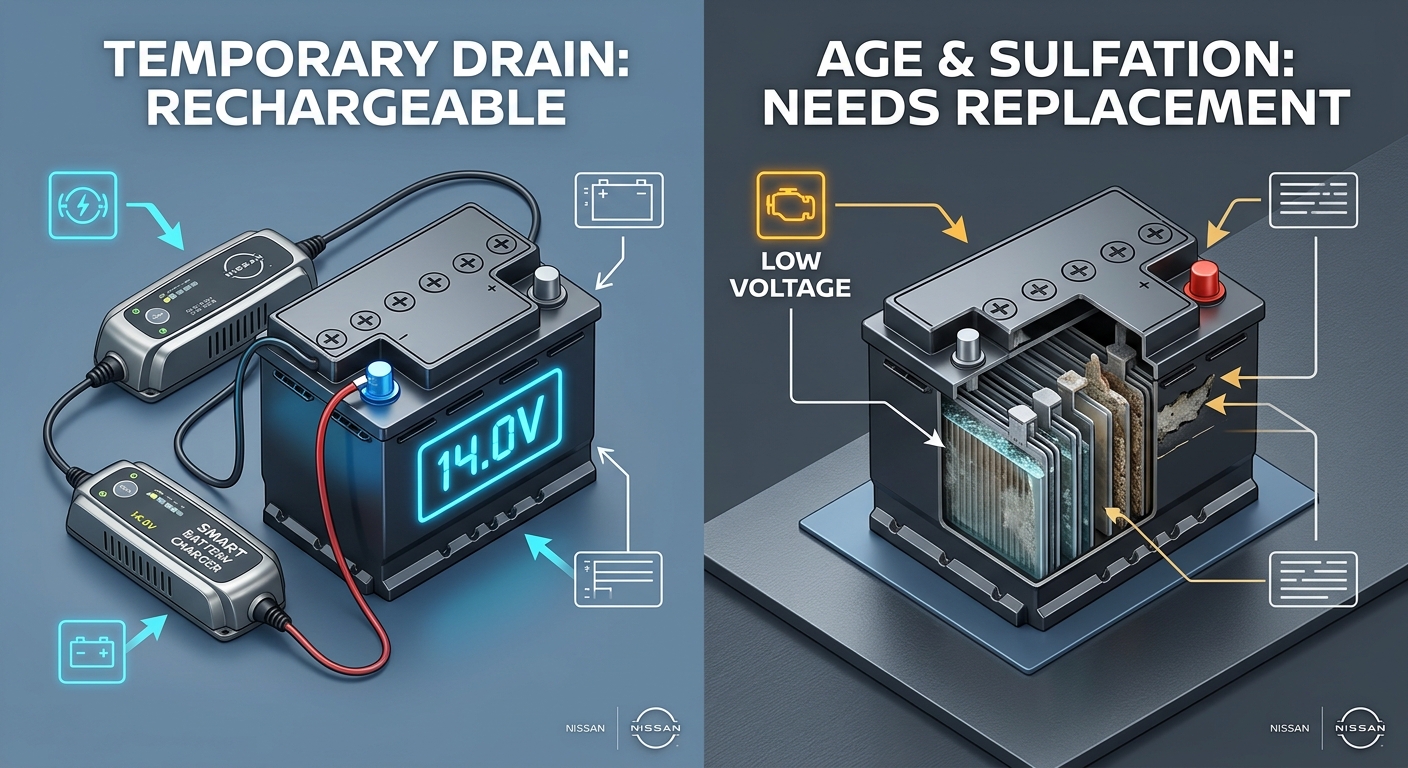
A Nissan battery causing slow engine cranking can sometimes be saved by charging if the discharge was caused by a temporary situation, such as leaving an interior light on or leaving the vehicle parked for several weeks. However, if the battery is over 3 to 4 years old or has developed internal grid degradation, charging will only provide a temporary surface charge before the slow cranking returns, requiring a complete replacement.
When drivers come into our service drive after noticing a slow engine crank on their vehicle, they almost always ask if putting the battery on a trickle charger overnight or taking a long drive will fix the issue permanently. A healthy 12V automotive battery relies on a precise chemical reaction between lead plates and sulfuric acid electrolyte to deliver the massive surge of cold cranking amps needed to turn over an engine. When an engine cranks slowly, it means the battery’s terminal voltage drops significantly under load. If the battery was simply drained because of a parasitic draw, running the engine or connecting a smart battery charger can restore full capacity. A 30-minute highway drive allows the alternator to output its normal charging voltage of 13.8 to 14.7 volts, replenishing the state of charge.
If internal chemical degradation or severe plate sulfation has taken hold, no amount of charging will rebuild the chemical capacity of the battery. Repeated deep discharges damage the internal cell structure, preventing the battery from holding a charge overnight. If you jump-start your vehicle or charge it back up, only to find the starter dragging again two days later, the battery has reached the end of its functional service life. Drivers interested in maintaining full electrical health can research new Nissan models to understand modern charging demands, or explore our lineup by taking a moment to visit our Nissan showroom. If you want to talk through your vehicle’s starting issues directly with our service team, feel free to give us a quick call or drop by our Shelbyville service center. Commuters evaluating high-efficiency options can also explore the new Nissan Altima or learn about Nissan EVs for alternative powertrain technology.
Table of Contents
- What Critical Signs Warn That Your Nissan Battery Is Dying?
- How Do Hot Summer Temperatures Affect Nissan 12V Battery Life?
- Why Do Nissan Stop-Start Systems and Electronics Require Specialized Batteries?
- What Does Professional Nissan Battery Replacement Cost and Cover Under Warranty?
- How Can Routine Battery Maintenance Prevent Roadside Breakdowns?
What Critical Signs Warn That Your Nissan Battery Is Dying?
A failing Nissan battery displays several clear warning signs before failing entirely, including a slow engine crank, dimming headlights, a clicking noise at startup, and electronic glitches across dashboard displays.
Recognizing early warning signs prevents the inconvenience of an engine that refuses to turn over in a driveway or parking lot. Beyond a sluggish starter motor, one of the first indicators of a weakening 12V battery is a rapid clicking sound when pressing the push-button ignition switch. This occurs when the starter solenoid engages, but the battery lacks sufficient power to maintain contact and turn the flywheel. Dashboard instrument clusters and infotainment screens may flicker or dim noticeably during cranking. Drivers traveling the rural back roads around Royal often notice these warning signs first during early morning starts when lower ambient temperatures put maximum resistance on a weakened battery.
Physical inspection of the battery under the hood provides additional clues regarding its health. Over time, internal pressure and thermal stress can cause the battery casing to swell or bulge at the sides. You may also spot a powdery blue-green oxidation build-up on the positive and negative terminals, which introduces electrical resistance and hampers current flow. In severe cases, a failing battery releases a pungent sulfur odor similar to rotten eggs, caused by gas leaking through internal vents or cracked casing walls. If you notice any of these symptoms while reviewing your vehicle maintenance or while browsing our pre-owned vehicle specials, immediate testing is essential. High-capacity family vehicles like those found when you shop new Nissan Armada inventory carry heavy electrical loads, making early diagnostic checks vital. Meanwhile, drivers transitioning away from gas engines entirely can shop new Nissan electric vehicles to discover zero-emission driving options.
Fuel Economy
Fuel economy and range by trim
| Feature | Dark Armor | Dark Armor AWD | Platinum AWD | Rock Creek AWD | S AWD | S FWD | SL AWD | SL FWD | SV AWD | SV FWD |
|---|---|---|---|---|---|---|---|---|---|---|
| MPG | 29 city / 36 hwy / 32 combined | 28 city / 35 hwy / 31 combined | 28 city / 35 hwy / 31 combined | 27 city / 32 hwy / 29 combined | 28 city / 35 hwy / 31 combined | 29 city / 36 hwy / 32 combined | 28 city / 35 hwy / 31 combined | 29 city / 36 hwy / 32 combined | 28 city / 35 hwy / 31 combined | 29 city / 36 hwy / 32 combined |
How Do Hot Summer Temperatures Affect Nissan 12V Battery Life?
Extreme summer heat in Middle Tennessee damages a 12V car battery far more severely than winter cold by accelerating internal corrosion and evaporating water from the liquid electrolyte solution.
While cold winter weather gets the blame for battery failures because it increases oil viscosity and slows down chemical reactions, high thermal conditions during summer are what actually destroy internal battery components. Under-hood temperatures during peak summer months can easily exceed 140 degrees Fahrenheit. This intense heat causes the liquid electrolyte inside conventional flooded batteries to evaporate, exposing internal lead plates to air and causing permanent sulfation. Heat also speeds up the internal chemical breakdown, causing grid corrosion that reduces the battery’s ability to hold a charge.
Batteries that suffer severe heat damage during July and August often manage to start the engine through the warm autumn months because warm engine oil offers lower resistance during cranking. However, as soon as the first cold snap hits, the damaged battery fails to produce the necessary cold cranking amps, leaving drivers stranded. Keeping the battery top clean, ensuring terminal clamps are secure, and keeping thermal heat shields in place help protect the unit. If your vehicle has experienced multiple summer seasons on its original battery, you can explore our current new-vehicle inventory to see the latest starting and charging technologies. Drivers needing reliable daily transportation can shop new Nissan cars or shop new Nissan Frontier inventory for rugged performance built to handle severe weather conditions.
Why Do Nissan Stop-Start Systems and Electronics Require Specialized Batteries?
Modern Nissan vehicles equipped with automatic stop-start systems and advanced driver-assist safety suites demand Enhanced Flooded Batteries (EFB) or Absorbed Glass Mat (AGM) batteries designed to handle rapid, high-frequency charge cycles.
Standard lead-acid batteries are built to provide a single, powerful burst of energy to start the engine and then sit at a steady state of charge while the alternator runs. In contrast, vehicles with stop-start technology shut off the combustion engine at traffic stops to conserve fuel, leaving the 12V battery to power the climate control, audio system, headlights, and safety sensors. Once the driver releases the brake pedal, the battery must immediately re-engage the starter motor. This continuous cycling rapidly degrades a standard battery, leading to premature failure within months if the wrong replacement battery type is installed.
AGM and EFB batteries feature thicker lead plates, reinforced casing materials, and specialized fiber glass mats that hold the electrolyte in place, enabling them to endure thousands of micro-cycles without losing structural integrity. Replacing an OEM AGM battery with a cheaper conventional battery can also trigger dashboard warning lights and disable power-saving features. When servicing modern vehicles, our factory-trained technicians register the new battery with the vehicle’s engine control module to reset the charging system algorithm, ensuring optimal charging voltage. Owners cross-shopping models can shop new Nissan Altima inventory, look through our options to browse new Nissan SUVs, or shop new Nissan Kicks inventory to find vehicles equipped with long-lasting EFB and AGM electrical architectures.
Engine & Performance
Powertrain specs by trim
| Feature | Dark Armor | Dark Armor AWD | Platinum AWD | Rock Creek AWD | S AWD | S FWD | SL AWD | SL FWD | SV AWD | SV FWD |
|---|---|---|---|---|---|---|---|---|---|---|
| Engine | 1.5L | 1.5L | 1.5L | 1.5L | 1.5L | 1.5L | 1.5L | 1.5L | 1.5L | 1.5L |
| Horsepower | 201 hp | 201 hp | 201 hp | 201 hp | 201 hp | 201 hp | 201 hp | 201 hp | 201 hp | 201 hp |
| Torque | 225 lb-ft | 225 lb-ft | 225 lb-ft | 225 lb-ft | 225 lb-ft | 225 lb-ft | 225 lb-ft | 225 lb-ft | 225 lb-ft | 225 lb-ft |
| Transmission | Xtronic | Xtronic | Xtronic | Xtronic | Xtronic | Xtronic | Xtronic | Xtronic | Xtronic | Xtronic |
| Drivetrain | Front-wheel drive | All-wheel drive | All-wheel drive | All-wheel drive | All-wheel drive | Front-wheel drive | All-wheel drive | Front-wheel drive | All-wheel drive | Front-wheel drive |
What Does Professional Nissan Battery Replacement Cost and Cover Under Warranty?
A professional Nissan 12V battery replacement typically costs between $150 and $300 for the unit itself, with professional installation, terminal anti-corrosion treatment, and system diagnostic resets ranging from $50 to $100.
Investing in a genuine Nissan replacement battery provides peace of mind through rigorous original equipment manufacturing standards and reliable performance. OEM batteries are engineered specifically for your vehicle’s amp-hour requirements and cold cranking specs. For instance, a vehicle like the 2026 Nissan Rogue SV AWD—with its 1.5L engine, Xtronic transmission, and a starting MSRP of $32,940—relies on a precisely rated battery to support its 201 hp powertrain, electronic control systems, and 29 city / 36 hwy fuel economy ratings. Installing the correct factory-spec battery ensures all electrical modules receive stable power without voltage fluctuations.
Genuine Nissan replacement batteries come backed by an expansive 84-month limited warranty program. This warranty generally includes 24-month full replacement coverage, followed by a pro-rated credit structure for the remaining months that reduces the cost of a future replacement if the battery fails early. To keep your vehicle operating at peak efficiency, our parts team can help you order genuine Nissan parts or guide you through current component options when you contact our parts team. You can also review our current parts specials to find seasonal offers, browse our main portal to order genuine Nissan parts online, or explore warranty options to keep your long-term ownership costs fully predictable.
Pricing
Pricing by trim
| Feature | Dark Armor | Dark Armor AWD | Platinum AWD | Rock Creek AWD | S AWD | S FWD | SL AWD | SL FWD | SV AWD | SV FWD |
|---|---|---|---|---|---|---|---|---|---|---|
| Base MSRP | $32,940 | $34,340 | $38,990 | $33,690 | $30,190 | $28,790 | $36,690 | $35,290 | $31,190 | $29,790 |
| Destination charge | $1,495 | $1,495 | $1,495 | $1,495 | $1,495 | $1,495 | $1,495 | $1,495 | $1,495 | $1,495 |
How Can Routine Battery Maintenance Prevent Roadside Breakdowns?
Routine battery inspection every three years, terminal cleaning, and secure tie-down mounting effectively prevent unexpected non-start situations and preserve vehicle electrical integrity.
Preventative maintenance remains the simplest way to avoid being stranded by a dead battery. During routine oil changes or multi-point inspections, technicians perform a digital load test that measures both static voltage and cold cranking capacity. If testing reveals that a battery’s internal conductance has dropped below healthy thresholds, replacing it proactively before complete failure saves time and stress. Drivers in Christiana frequently rely on their vehicles for daily commutes along Interstate 24 into neighboring employment hubs, making routine pre-trip battery checks an essential part of basic vehicle care.
Routine maintenance includes keeping battery posts clean and tight. Blue green corrosion on the terminals can be safely cleaned using a mixture of baking soda and water, followed by a thorough rinse and application of a protective anti-corrosion spray. Ensuring the battery hold-down bracket is properly tightened prevents vibration damage, which can loosen internal plate connections over rough roads. If an unexpected battery failure occurs away from home, owners can rely on Nissan Roadside Assistance: (800) 225-2476 for prompt jump-start support or towing to an authorized service facility.
To keep your starting system working smoothly, you can schedule battery service directly with our certified technicians, or use our online portal to schedule maintenance online at your convenience. For comprehensive vehicle care, drivers can schedule your service today or reach out to contact our service team for professional diagnosis. Additional vehicle care resources are available when you get roadside assistance info or choose to schedule your Nissan service with our local Shelbyville team.
0 comment(s) so far on What You Should Know About Nissan Battery Maintenance and Replacement