

What Tools Are Required for a Brake Job?
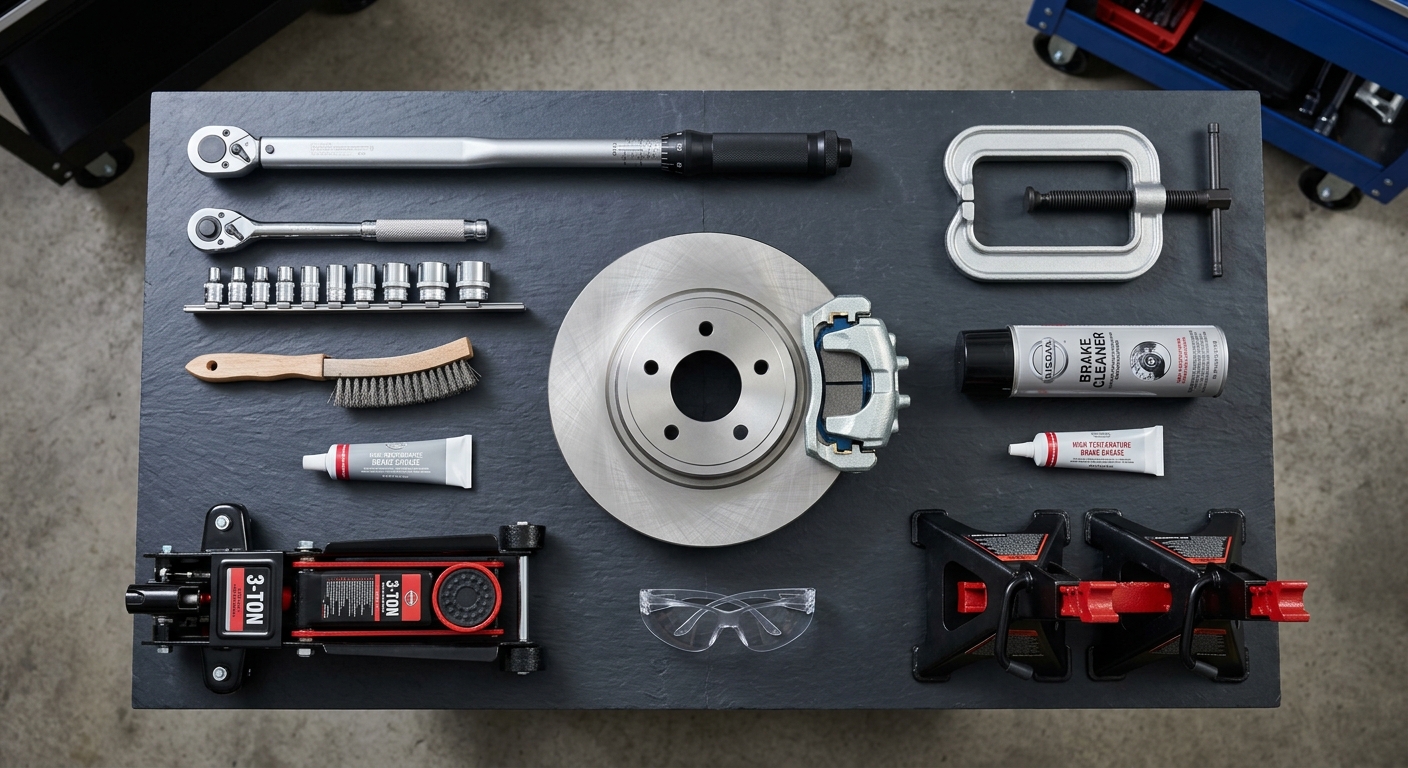
Performing a complete DIY brake pad and rotor replacement requires a hydraulic floor jack, jack stands, wheel chocks, a lug wrench, a metric socket and ratchet set, a torque wrench, a caliper piston compression tool or C-clamp, a wire brush, brake cleaner, high-temperature brake grease, and safety eyewear. Having these tools prepared ensures safe vehicle lifting, proper caliper clearance, accurate bolt torquing, and squeak-free pad seating.
Working on a vehicle brake system begins with vehicle elevation and stabilization. A hydraulic floor jack rated for your vehicle’s weight raises the chassis, while heavy-duty jack stands secure the axle or frame rails before removing the wheels with a standard socket or lug wrench.
Accessing the brake assembly requires specific socket sizes—typically 12mm, 14mm, 17mm, or 18mm depending on the model—to detach the caliper guide pin bolts and caliper mounting brackets. Retracting the inner caliper piston to make room for thick, new friction pads requires a disc brake pad spreader or C-clamp. On vehicles equipped with an electronic parking brake on the rear axle, a specialized wind-back tool or diagnostic scan tool is necessary to retract the parking brake actuator safely without damaging internal threads.
Cleaning and lubricating metal contact points are necessary steps during assembly. A wire brush removes rust scale from the caliper bracket slides and wheel hub surface, while brake-cleaning spray washes away friction dust and oil residue from new rotor faces. Applying synthetic high-temperature brake lubricant to slide pins and pad abutment clips prevents sticking and noise, while keeping grease away from the friction face. Finishing the installation requires a calibrated torque wrench capable of tightening caliper bolts and lug nuts to factory torque ranges between 25 and 100 lb-ft.
Regular inspections remain the best way to catch worn components early. Routine maintenance guides for models like the 2026 Nissan Frontier call for pad and rotor inspections every 15,000 miles or 12 months under standard driving routines, or every 5,000 miles under frequent severe use. Drivers who prefer expert technician service can contact our Shelbyville service center or give our team a quick call to verify tool specifications and scheduling.
Table of Contents
- What Are the Critical Symptoms That Signal Your Vehicle Needs Immediate Brake Service?
- Are Ceramic Brake Pads More Expensive Than Semi-Metallic Pads?
- How Much Does Complete Brake Service Cost?
- How Do Driving Conditions Affect Brake Wear and Fluid Lifespan?
- Why Choose Genuine OEM Nissan Parts and Certified Brake Technicians?
- Frequently Asked Questions About Vehicle Brake Maintenance
- Schedule Your Next Brake Service at Newton Nissan South
What Are the Critical Symptoms That Signal Your Vehicle Needs Immediate Brake Service?
High-pitched squealing noises, steering wheel vibration, grinding during deceleration, a soft or spongy pedal, and pulling to one side indicate severe brake component wear or hydraulic system failure. Inspecting friction linings immediately when these symptoms appear prevents rotor scoring, extended stopping distances, and costly hydraulic repairs.
A high-pitched metallic squeal while slowing down is usually the first warning sign. Brake pads feature built-in steel wear indicator tabs that make contact with the rotor face once the friction material wears down to approximately 2 millimeters. Ignoring this squeal allows the lining to wear out completely, resulting in a harsh metal-on-metal grinding sound. Metal grinding means the steel backing plate is gouging into the brake rotor, damaging the smooth surface and requiring full rotor replacement.
Vibration or pulsation felt through the brake pedal or steering wheel signals rotor thickness variation or surface warping. Intense friction heat causes localized hotspots on the rotor face, creating uneven surface spots that push back against the caliper pads during braking. Spongy or soft pedal feel points to air in the hydraulic lines or moisture buildup inside the brake fluid reservoir. Because brake fluid naturally attracts ambient moisture, official guidelines recommend a complete hydraulic fluid flush at 30,000 miles or 24 months to restore firm pedal pressure and prevent internal cylinder corrosion.
Dashboard warning lights provide additional diagnostic feedback. A red brake warning lamp indicates low fluid levels, severe hydraulic pressure drop, or an engaged parking brake, whereas an amber ABS light points to an anti-lock sensor or control module fault. Commuters traveling from Christiana toward Murfreesboro along Interstate 24 experience frequent stop-and-go deceleration that rapidly increases friction temperatures. Vehicles loaded with gear or passengers, such as the 2026 Nissan Rogue with its 1.5L turbocharged engine and Xtronic transmission, require fully functional friction surfaces to maintain confident stopping capability. Drivers seeking upgraded family transportation can browse our new Nissan crossover and SUV inventory or check out our pre-owned vehicle specials for reliable daily transport.
Are Ceramic Brake Pads More Expensive Than Semi-Metallic Pads?
Ceramic brake pads generally cost $20 to $50 more per set than semi-metallic pads due to their advanced material composition and refined manufacturing process. Despite the higher initial price tag, ceramic pads provide quieter operation, lower dust generation, and extended rotor surface life for everyday passenger vehicles.
Semi-metallic brake pads consist of 30 to 65 percent metal materials, including steel wool, wire, copper, and iron bonded with graphite and synthetic resins. This dense metallic structure excels at transferring heat away from the rotor face, making semi-metallic compounds well-suited for heavy-duty hauling or towing applications, such as the 2026 Nissan Frontier powered by a 3.8L V6 engine producing strong low-end pulling power and a maximum towing capacity of 6,680 lbs. However, semi-metallic materials wear rotors faster, generate dark metallic wheel dust, and produce more ambient squeal under light pedal pressure.
Ceramic friction materials utilize dense ceramic fibers mixed with non-ferrous filler materials and fine copper strands. This engineering balance offers distinct practical advantages for daily commuting:
- Reduced operational noise due to sound-damping material density.
- Non-abrasive composition that minimizes rotor face wear.
- Fine, light-colored brake dust that does not easily cling to alloy wheels.
- Stable friction performance across normal urban temperature ranges.
Selecting between friction materials depends on vehicle utility and driver preferences. Daily commuters evaluating vehicles like the 2026 Nissan Altima often ask about cabin noise levels and rim maintenance before choosing replacement pads. Owners considering an upgrade or trade-in can value your trade-in online to explore current vehicle equity before servicing an older vehicle.
How Much Does Complete Brake Service Cost?
Standard brake pad replacement costs between $150 and $300 per axle, while comprehensive brake service including new pads, turned or replaced rotors, and fresh hardware ranges from $400 to $600 per axle. Hydraulic fluid flushes typically add $80 to $130 to total vehicle service costs.
Service estimates include both physical replacement components and certified technician labor. Pad-only service replaces worn friction material, lubricates caliper guide pins, and cleans bracket mounting surfaces. When rotors exhibit light surface scoring or uneven wear, technicians measure the remaining disc thickness with a micrometer to determine if the rotor can be resurfaced on a lathe or must be replaced entirely. Servicing both the front and rear axles during a single service appointment often reduces total labor charges by streamlining inspection and lift setup processes.
Vehicle specification and drivetrain complexity influence service overhead and maintenance planning. For instance, the 2026 Nissan Altima lineup features distinct trim levels and drivetrain options:
- 2.5 SV: Base MSRP of $27,580 with a $1,245 destination charge.
- 2.5 SV AWD: Base MSRP of $29,080 with a $1,245 destination charge.
- 2.5 SR: Base MSRP of $28,980 with a $1,245 destination charge.
- 2.5 SR AWD: Base MSRP of $30,480 with a $1,245 destination charge.
All-wheel-drive configurations incorporate additional rear drivetrain components that require careful inspection during routine underbody visits. Drivers can schedule a service appointment to receive a clear inspection report, or apply for service financing options to manage unexpected repair expenses conveniently.
Pricing
Pricing by trim
| Feature | 2.5 SR | 2.5 SR AWD | 2.5 SV | 2.5 SV AWD |
|---|---|---|---|---|
| Base MSRP | $28,980 | $30,480 | $27,580 | $29,080 |
| Destination charge | $1,245 | $1,245 | $1,245 | $1,245 |
How Do Driving Conditions Affect Brake Wear and Fluid Lifespan?
Frequent stop-and-go city driving, downhill mountain travel, heavy cargo hauling, and aggressive braking create elevated thermal energy that accelerates friction material wear and breaks down hydraulic fluid chemistry. Under rigorous operating conditions, brake fluid absorbs atmospheric moisture faster and requires more frequent replacement than standard service schedules recommend.
Kinetic energy transforms directly into friction heat when brake pads clamp down on spinning rotors. In dense city traffic or hilly terrain, brakes lack sufficient cooling time between stops, driving internal assembly temperatures beyond normal operating bands. This continuous thermal stress causes surface glazing on brake pads—crystallizing the friction material into a slick finish that reduces stopping power and requires greater pedal force.
Regional topography directly affects component longevity. Navigating the hilly country terrain and agricultural back roads surrounding Royal requires steady pedal application during prolonged downhill descents. Sustained braking on inclines heats caliper assemblies, causing glycol-based brake fluid to absorb moisture through microscopic pores in flexible rubber hoses. As water content in the fluid rises above 3 percent, the boiling point drops significantly, creating vapor bubbles under heavy braking that result in a soft pedal feel and reduced hydraulic pressure.
Official maintenance guides emphasize adjusted service schedules for severe driving patterns:
- Standard routine: Brake fluid flush every 30,000 miles or 24 months.
- Severe routine: Inspection every 5,000 to 10,000 miles, with complete fluid replacement every 20,000 miles or 24 months as outlined in guidelines for models like the 2026 Nissan Kicks.
- Visual check: Inspecting rotor thickness and pad lining every 15,000 miles to spot uneven inner pad wear early.
Why Choose Genuine OEM Nissan Parts and Certified Brake Technicians?
Genuine OEM Nissan brake parts are engineered to match factory dimensions, friction coefficients, and acoustic standards, ensuring reliable stopping performance and precise vehicle fitment. Certified technicians possess specialized factory training and specialized diagnostic tools required to maintain advanced anti-lock braking and electronic stability control systems.
Aftermarket brake components are manufactured to fit a wide array of generic vehicle applications, frequently resulting in improper backing plate tolerances, pad rattle, or premature rotor wear. In contrast, OEM Nissan brake pads feature pre-attached, factory-calibrated shims designed specifically to eliminate high-frequency acoustic squeal. Original rotors use high-grade cast iron alloys that deliver consistent heat dissipation and resist thermal cracking under heavy stopping demands.
Certified technicians follow strict factory procedures during every brake service step:
- Measuring rotor face thickness with precision micrometers against minimum safety discard limits.
- Cleaning hub mounting surfaces to eliminate lateral rotor runout.
- Inspecting caliper piston boots and guide pin seals for heat cracking or fluid leaks.
- Performing hydraulic system pressure bleeding to remove trapped air bubbles completely.
Drivers traveling near the open fields around Union Grove count on original components to resist fine road dust and farm road grit without binding caliper slides. Vehicle owners evaluating replacement options can review our Newton Certified pre-owned selection for dependable inventory, or order genuine Nissan parts online for direct factory replacements.
Frequently Asked Questions About Vehicle Brake Maintenance
Q: How should new brake pads and rotors be broken in after installation?
Properly breaking in, or bedding, new brake pads involves performing 4 to 5 moderate decelerations from 45 mph down to 15 mph without coming to a complete stop, allowing brief cooling periods between slowdowns. This process transfers an even, microscopic layer of friction material from the pad onto the rotor surface, preventing vibration and squealing while optimizing stopping performance.
Q: Can driving with severely worn brake pads damage other suspension components?
Yes, driving with completely worn brake pads allows extreme friction heat to transfer directly from the metal backing plate into the caliper piston and wheel hub assembly. This excessive heat can melt wheel bearing grease, damage rubber caliper seals, and cook suspension ball joint boots, leading to secondary component failures. Combining routine brake service with understanding tire tread health and safety ensures total vehicle stability.
Q: What causes dark brake dust to build up on front alloy wheels?
Dark brake dust is composed of microscopic carbon and metallic particles shed from the brake pad lining as it wears against the rotor face during normal stopping. Front wheels collect significantly more dust than rear wheels because front brakes perform up to 70 percent of total stopping force, generating higher heat and material shedding.
Q: Is it safe to replace only the front brake pads if the rear pads still have lining left?
Replacing only front brake pads is acceptable if an inspection confirms that the rear pads retain adequate lining thickness and the rear rotors show no surface grooving or lateral runout. Because front brakes experience faster wear due to forward weight transfer during deceleration, front friction pads frequently require replacement twice as often as rear pads.
Q: Why does my brake pedal feel spongy even after installing brand-new pads?
A spongy pedal after installing new pads usually indicates that air bubbles were introduced into the hydraulic lines during service or that caliper guide pins are binding. Bleeding the hydraulic system with fresh fluid removes trapped air bubbles, restoring firm pedal pressure and crisp caliper engagement.
Engine & Performance
Powertrain specs by trim
| Feature | 2.5 SR | 2.5 SR AWD | 2.5 SV | 2.5 SV AWD |
|---|---|---|---|---|
| Engine | 2.5L | 2.5L | 2.5L | 2.5L |
| Horsepower | 188 hp | 182 hp | 188 hp | 182 hp |
| Torque | 180 lb-ft | 178 lb-ft | 180 lb-ft | 178 lb-ft |
| Transmission | Xtronic | Xtronic | Xtronic | Xtronic |
| Drivetrain | Front-wheel drive | All-wheel drive | Front-wheel drive | All-wheel drive |
Fuel Economy
Fuel economy and range by trim
| Feature | 2.5 SR | 2.5 SR AWD | 2.5 SV | 2.5 SV AWD |
|---|---|---|---|---|
| MPG | 26 city / 36 hwy / 30 combined | 25 city / 33 hwy / 28 combined | 26 city / 36 hwy / 30 combined | 25 city / 33 hwy / 28 combined |
Schedule Your Next Brake Service at Newton Nissan South
Regular brake inspections, timely pad replacements, and fluid flushes protect your vehicle’s safety on Middle Tennessee roads while preserving long-term resale value. Contact our certified service department today to ensure your vehicle stops smoothly, quietly, and dependably.
Our factory-trained service team is ready to inspect your friction pads, turn or replace rotors, and perform complete hydraulic flushes using genuine OEM components. You can visit our Shelbyville service facility, give our service advisors a quick call, or easily schedule your brake service online to reserve your preferred appointment time.
0 comment(s) so far on What Tools Are Required for a Brake Job?