

What Are the Signs I Need a Brake Service?
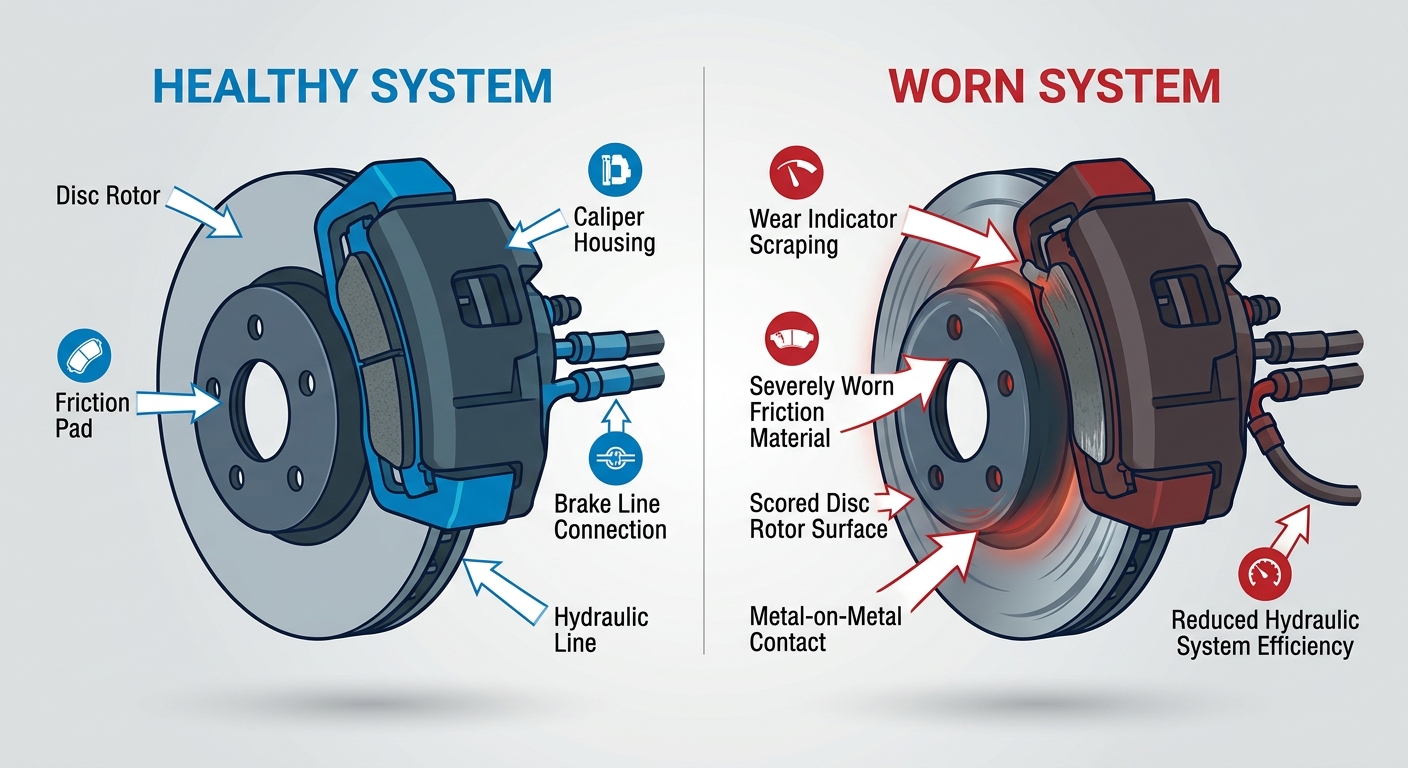
High-pitched squealing from built-in wear indicators, metallic grinding, a soft or spongy pedal, steering wheel vibration while stopping, or pulling to one side are the primary signs your brakes need service. Addressing these early warning indicators prevents rotor damage, restores proper hydraulic system pressure, and maintains safe stopping distances.
Automotive braking systems rely on hydraulic pressure pushing friction materials against metal discs. Over time, that friction strips away pad material. Modern friction discs incorporate a tiny metal tab called a wear indicator. When pad material wears down to approximately 2 millimeters to 3 millimeters of thickness, this indicator contacts the rotor, producing a high-pitched squeal whenever you apply pressure to the pedal. Ignoring this squeal allows friction material to wear away completely, causing the steel backing plate to press directly against the rotor disk.
Changes in pedal feel provide another clear warning of system degradation. A firm, responsive pedal indicates tight hydraulic pressure and healthy friction pads. If the pedal feels soft or spongy, or if it sinks further toward the floorboard than usual before engaging the pads, air has likely entered the hydraulic fluid lines, or fluid levels have dropped. According to safety guidance from the National Highway Traffic Safety Administration (NHTSA), a dropping fluid level or an active warning light often signals an external leak that requires immediate professional evaluation.
Physical vibrations during deceleration point directly to uneven rotor surfaces or lateral runout. As friction pads create intense heat during heavy braking, rotors expand and contract. Over thousands of miles, uneven heat transfer can create microscopic high and low spots across the steel surface. When the calipers clamp down on an uneven rotor, the variation pushes back through the hydraulic lines, creating a pulse in the brake pedal or a rhythmic shimmy through the steering wheel.
When local drivers bring in a vehicle after commuting along Interstate 24 from Christiana, our technicians frequently inspect friction surfaces to determine whether morning squeaks stem from routine surface moisture or critical material wear. If you suspect your vehicle is exhibiting any of these symptoms, you can get exact directions to our Shelbyville service center or contact our service team directly by giving us a quick call at (931) 536-3118.
Table of Contents
- What Are the Warning Signs That Require Immediate Brake Repair?
- How Much Does a Typical Brake Service Cost?
- Are Ceramic Brake Pads Worth the Extra Cost Over Semi-Metallic?
- How Much Is a Brake Fluid Flush and How Often Is It Needed?
- How Do Local Roads Impact Your Nissan Brake Maintenance Schedule?
- Common Questions About Nissan Brake Maintenance and Repairs
- Schedule Your Nissan Brake Inspection Today
What Are the Warning Signs That Require Immediate Brake Repair?
Immediate brake repair is required if you hear harsh metal-on-metal grinding, experience a pedal that sinks completely to the floorboard, observe an illuminated red brake system warning light, or feel severe vehicle pull to one side under deceleration. Continuing to operate a vehicle under these conditions risks total hydraulic failure and severe mechanical destruction.
Harsh grinding indicates that the friction lining has worn away entirely. The bare steel backing plate of the pad is grinding directly against the cast-iron rotor surface. This metal-on-metal contact cuts deep gouges into the rotor face within a few miles, generating intense localized heat that can warp calipers, destroy wheel cylinder seals, and dramatically increase stopping distances.
A pedal that goes straight to the floor signals a catastrophic loss of hydraulic pressure. Modern vehicles utilize a dual-circuit master cylinder, splitting fluid delivery between front and rear or diagonal wheel pairs. If a brake hose ruptures, a caliper seal fails, or fluid levels drop dangerously low, hydraulic pressure drops across that circuit. This condition requires immediate stopping in a safe location, followed by a tow service rather than attempting to drive to a shop.
Uneven braking force that pulls the steering wheel sharply toward one side usually indicates a seized caliper piston or a contaminated pad surface. If a sliding pin corrodes or a caliper piston binds inside its bore, one wheel remains locked in constant contact while another fails to apply friction. This drag heats the affected hub assembly to extreme temperatures, accelerating tire wear and threatening wheel bearing integrity.
Maintaining peak stopping capability relies on replacing degraded hardware with factory-specified components before catastrophic wear occurs. Drivers can maintain original factory performance standards by ordering authentic Nissan brake pads and rotors directly through our dealership, ensuring precise fitment for heavier vehicles like our latest lineup of new Nissan SUVs like the 2026 Nissan Rogue.
Fuel Economy
Fuel economy and range by trim
| Feature | 2.5 SR | 2.5 SR AWD | 2.5 SV | 2.5 SV AWD |
|---|---|---|---|---|
| MPG | 26 city / 36 hwy / 30 combined | 25 city / 33 hwy / 28 combined | 26 city / 36 hwy / 30 combined | 25 city / 33 hwy / 28 combined |
How Much Does a Typical Brake Service Cost?
A standard brake pad replacement generally ranges from $150 to $300 per axle for parts and labor, while a complete brake service involving pad replacement and new rotors typically costs between $400 and $600 per axle. Total repair expenses vary based on vehicle classification, friction material choice, and whether shop technicians must resurface or completely replace the rotors.
Routine pad replacement costs cover removing worn hardware, cleaning caliper brackets, replacing anti-rattle clips, applying high-temperature brake lubricant to slide pins, and installing fresh pad sets. Labor charges account for the time required to bleed hydraulic lines when necessary and test-drive the vehicle to properly bed in the new friction material. Bundling service across both front and rear axles during a single appointment often reduces overall labor overhead.
Vehicle size and drivetrain configuration directly influence component replacement costs. Heavier models or all-wheel-drive sedans require larger friction pads and thicker rotors to manage additional kinetic energy. For instance, the front-wheel-drive 2026 Nissan Altima 2.5 SV carries a starting MSRP of $27,580 (plus a $1,275 destination charge), while the 2026 Nissan Altima 2.5 SV AWD starts at $29,080 MSRP (plus $1,275 destination). Moving up to performance-focused trims, the 2026 Nissan Altima 2.5 SR starts at $28,980 MSRP (plus $1,275 destination), and the 2026 Nissan Altima 2.5 SR AWD sits at $30,480 MSRP (plus $1,275 destination). All-wheel-drive systems add driveline components that require precise rotor thickness tolerances to ensure smooth, balanced braking across all four wheels.
Rotor condition determines whether resurfacing or full replacement is necessary. If a rotor retains sufficient discarded thickness specifications and exhibits no structural heat cracks, a technician can turn the rotor on a lathe to restore a smooth face. However, modern lightweight rotors are engineered closer to minimum thickness tolerances to reduce un-sprung vehicle weight, making full rotor replacement the standard practice for long-term reliability.
Drivers planning their maintenance budget can start by scheduling a routine brake inspection online with our certified team. If you are currently shopping for an economical daily vehicle, take a moment to evaluate overall vehicle maintenance records while checking our featured pre-owned vehicle specials.
Pricing
Pricing by trim
| Feature | 2.5 SR | 2.5 SR AWD | 2.5 SV | 2.5 SV AWD |
|---|---|---|---|---|
| Base MSRP | $28,980 | $30,480 | $27,580 | $29,080 |
| Destination charge | $1,275 | $1,275 | $1,275 | $1,275 |
Are Ceramic Brake Pads Worth the Extra Cost Over Semi-Metallic?
Ceramic brake pads are worth the higher upfront cost for daily drivers who prioritize silent operation, minimal dust accumulation on wheels, and extended rotor lifespan, though semi-metallic pads remain the superior option for heavy towing and track-level heat management.
Friction materials are categorized primarily into organic, semi-metallic, and ceramic compounds:
- Semi-Metallic Brake Pads: Manufactured from a combination of steel, iron, copper, and synthetic graphite bonded together. Metallic pads offer exceptional heat dissipation and strong cold-bite engagement. However, they generate noticeable brake dust, wear rotors down faster, and produce higher noise levels under ambient thermal changes.
- Ceramic Brake Pads: Formulated from dense ceramic materials embedded with fine copper fibers. Ceramic compounds absorb operational noise at frequencies outside human hearing ranges and produce light-colored dust that does not stick to wheel surfaces. They operate cleanly and gently against iron rotors, extending rotor lifespan significantly.
- Low-Metallic Organic Pads: Offer soft initial bite and quiet operation but wear down rapidly under high thermal stress and release dark particulate matter.
For standard commuter sedans and everyday crossover vehicles, ceramic pads offer a quieter cabin experience and lower long-term rotor replacement frequency. Semi-metallic pads remain the recommended choice for trucks carrying maximum payload or towing heavy trailers, where thermal transfer through steel fibers prevents pad glaze under prolonged downhill braking.
Evaluating component integrity is equally vital when considering pre-owned vehicles. Buyers can review comprehensive multi-point reconditioning reports by exploring certified pre-owned Nissan vehicles at our dealership, where braking systems are measured and brought back to strict factory safety limits before hitting the lot.
How Much Is a Brake Fluid Flush and How Often Is It Needed?
A professional brake fluid flush typically costs between $80 and $130, with Nissan recommending fluid replacement every 20,000 miles to 30,000 miles or 24 months under standard driving conditions. Operating under severe conditions—such as frequent mountainous driving, regular short trips, or heavy towing—shortens this service interval to every 10,000 miles or 12 months.
Brake fluid operates in a sealed hydraulic system, translating foot pressure at the pedal into physical clamping force at the wheels. Most passenger vehicles use DOT 3 or DOT 4 glycol-based fluids, which are inherently hygroscopic—meaning they absorb moisture directly from ambient air through flexible rubber lines and reservoir vents over time.
Moisture contamination significantly lowers the fluid’s boiling point. Under heavy braking, heated calipers transfer thermal energy into fresh fluid without issue. However, if moisture content reaches 3 percent or higher, that trapped water turns to steam under heat. Because steam compresses while liquid does not, severe thermal stress results in a pedal that drops to the floorboard without applying clamping force. Furthermore, water inside the lines corrodes internal master cylinder pistons, abs valves, and caliper bores from the inside out.
Vehicle curb weight directly impacts how hard hydraulic systems must work to shed speed. For example, the 2026 Nissan Altima 2.5 SV weighs 3,283 lbs in front-wheel drive and 3,401 lbs in all-wheel drive, maintaining a 5-passenger seating capacity and about 15 cu ft of trunk cargo space. The 2026 Nissan Altima 2.5 SR comes in at 3,323 lbs (FWD) and 3,442 lbs (AWD), keeping that same about 15 cu ft cargo volume. Stopping these vehicles efficiently relies on clean, moisture-free fluid delivering consistent hydraulic force to every caliper.
Official factory service guidelines outline clear fluid maintenance schedules:
- Nissan Frontier: Replace brake fluid every 30,000 miles or 24 months under standard conditions; replace every 10,000 miles or 12 months under severe conditions.
- Nissan Kicks: Replace brake fluid every 20,000 miles or 24 months under standard conditions; replace every 10,000 miles or 12 months under severe conditions.
Owners planning to transition into a new vehicle can explore upgrade options by getting a competitive offer to sell your current car directly to our dealership team.
Dimensions & Capacity
Capacity and dimensions by trim
| Feature | 2.5 SR | 2.5 SR AWD | 2.5 SV | 2.5 SV AWD |
|---|---|---|---|---|
| Seating | 5 | 5 | 5 | 5 |
| Cargo | 15.4 cu ft | 15.4 cu ft | 15.4 cu ft | 15.4 cu ft |
| Curb weight | 3,323 lbs | 3,442 lbs | 3,283 lbs | 3,401 lbs |
How Do Local Roads Impact Your Nissan Brake Maintenance Schedule?
Driving across rural dirt roads, hilly farm terrain, and high-speed highway traffic corridors accelerates wear on pads, rotors, and hydraulic seals, requiring more frequent inspection intervals than urban driving. Nissan guidelines specify inspecting brake pads and rotors every 15,000 miles or 12 months under standard conditions, but shortening that interval to every 5,000 miles or 6 months under severe driving conditions.
Navigating the undulating terrain around Royal, where farm machinery operates along gravel back roads and secondary highways, demands frequent brake modulations. Fine dust grit from unpaved surfaces settles into caliper slider pins and anti-rattle brackets. Without routine cleaning and lubrication, grit binds sliding calipers, forcing pads to drag against the rotor face even when your foot is off the pedal.
Severe driving conditions that warrant a 5,000-mile inspection schedule include:
- Driving in mud, sand, or deep dust environments that contaminate pad friction surfaces.
- Repeated towing of recreational trailers or hauling heavy equipment loads.
- Frequent short trips under 5 miles in freezing or highly humid ambient weather.
- Continuous stop-and-go driving during daily work commutes.
Regular multi-point brake checks catch uneven wear patterns, caliper pin binding, and microscopic fluid seepage long before they cause mechanical breakdowns. If your vehicle requires unexpected rotor replacements or major caliper overhauls, you can manage maintenance costs seamlessly by applying for service financing online through our dealership portal.
Common Questions About Nissan Brake Maintenance and Repairs
How long do original OEM brake pads typically last on a new vehicle?
Original Nissan OEM brake pads generally last between 30,000 and 70,000 miles, depending on driving habits, vehicle weight, and road conditions. Commuters who log highway miles experience significantly less friction wear than drivers navigating heavy city stop-and-go traffic. Regular visual inspections during 5,000-mile oil changes ensure you track pad thickness accurately over time.
Why do my brakes squeak only first thing in the morning?
Morning brake squeal is usually caused by a thin layer of flash rust that forms on cast-iron rotors overnight due to ambient humidity or dew. When you apply the brakes during the first few stops, the friction pads sweep this surface oxidation away, returning the system to quiet operation. If the squeal persists throughout your drive, it indicates a mechanical wear tab contacting the rotor.
Can I replace just the brake pads without turning or replacing the rotors?
Replacing pads without addressing rotors—known as a pad slap—is not recommended. Fitting flat, new friction pads onto a rotor with grooves or heat scoring reduces pad contact area, increases noise, and leads to premature pad wear. Machining or replacing rotors alongside fresh pads guarantees a true mating surface and predictable stopping performance.
Does my vehicle warranty cover worn brake pads and rotors?
Brake pads and rotors are considered wear-and-tear friction items and are generally not covered under standard bumper-to-bumper or powertrain limited warranties unless a manufacturing defect causes premature failure. However, hydraulic components like master cylinders, ABS modulators, and brake calipers are typically covered during the active limited warranty period.
What causes a brake pedal to feel spongy or sink to the floorboard?
A spongy pedal indicates that air has entered the hydraulic lines or the brake fluid has absorbed excessive moisture, lowering its boiling point and allowing gas bubbles to compress inside the system. A pedal that slowly sinks to the floor under constant pressure often signals an internal fluid leak past the master cylinder primary piston seals, requiring immediate service.
If you have additional technical questions about your vehicle’s braking system, you can ensure peak stopping performance by booking your official Nissan service appointment or learning more about Nissan Frontier durability and maintenance standards.
Schedule Your Nissan Brake Inspection Today
Protecting your vehicle’s stopping power starts with proactive maintenance and factory-certified inspections. Whether you need routine fluid flushes, friction pad replacements, or complete rotor resurfacing, our team at Newton Nissan South delivers expert service backed by genuine parts.
Our Nissan-certified technicians perform thorough multi-point brake checks, evaluating pad thickness, rotor runout, caliper slider movement, and hydraulic fluid purity. Addressing minor squeaks or pedal changes early keeps your vehicle operating safely while saving you money on major mechanical repairs down the road.
Schedule your next maintenance visit today by exploring our available service slots online, visiting our service facility at 2801 US Highway 231 in Shelbyville, or speaking directly with our advisors by calling (931) 536-3118. We look forward to helping you keep your vehicle running smoothly and stopping safely. Have questions about brake service? Call Newton Nissan South at a quick call at (931) 536-3118.
Engine & Performance
Powertrain specs by trim
| Feature | 2.5 SR | 2.5 SR AWD | 2.5 SV | 2.5 SV AWD |
|---|---|---|---|---|
| Engine | 2.5L | 2.5L | 2.5L | 2.5L |
| Horsepower | 188 hp | 182 hp | 188 hp | 182 hp |
| Torque | 180 lb-ft | 178 lb-ft | 180 lb-ft | 178 lb-ft |
| Transmission | Xtronic | Xtronic | Xtronic | Xtronic |
| Drivetrain | Front-wheel drive | All-wheel drive | Front-wheel drive | All-wheel drive |
0 comment(s) so far on What Are the Signs I Need a Brake Service?