

How Old Brake Fluid Dampens the Performance of New Pads and Rotors
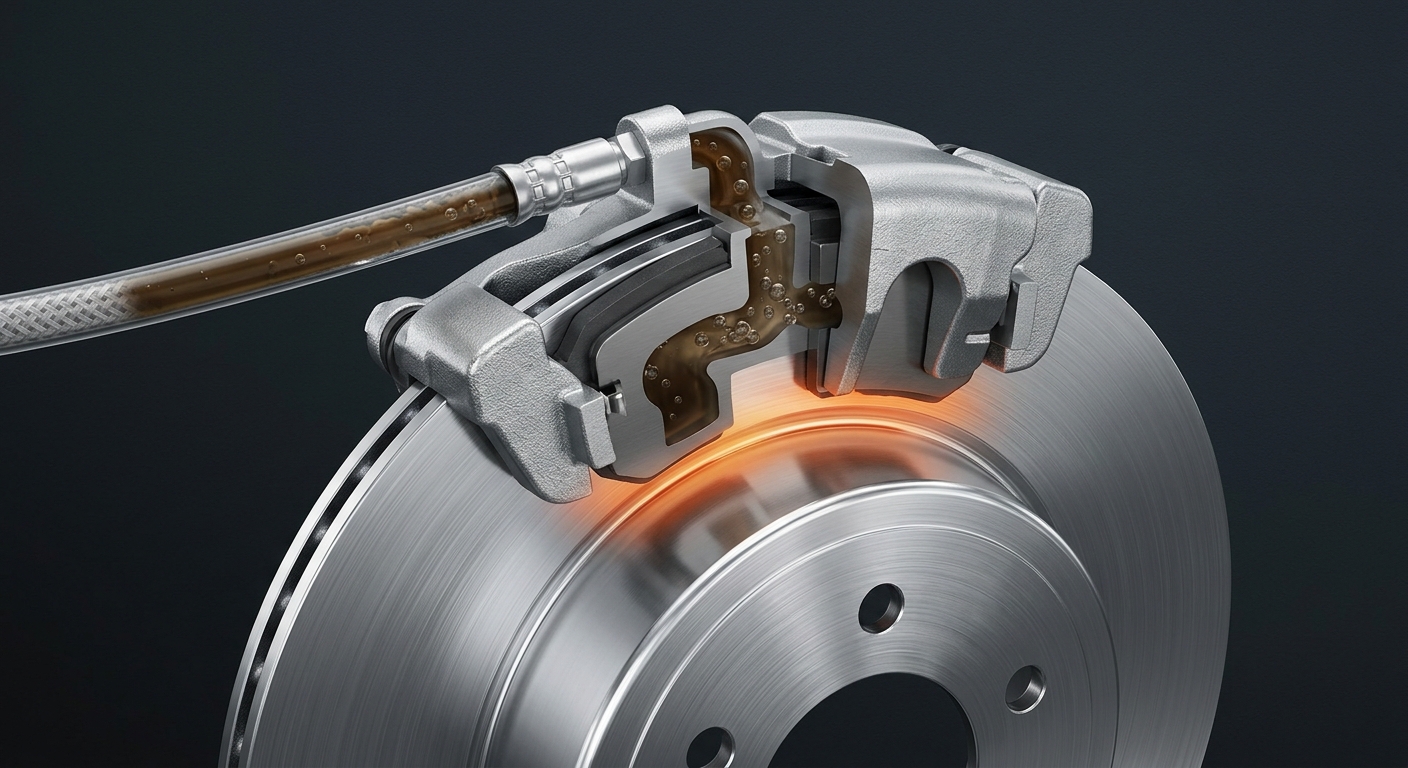
Investing in brand-new brake pads and rotors is a great step toward restoring your vehicle’s stopping power. However, pairing those fresh mechanical components with old, degraded hydraulic fluid can severely limit their effectiveness. The physical contact between the pad and the rotor is only the final stage of a complex process that begins when your foot presses the pedal. If the hydraulic medium responsible for transferring that force is compromised, even the highest-quality friction materials cannot perform as designed.
Brake systems rely on a completely sealed, pressurized column of liquid to transmit force from the master cylinder to the calipers. When you press the pedal, this pressure forces the calipers to squeeze the pads against the spinning rotors. If the fluid in those lines is old and contaminated with moisture, it compresses under pressure instead of remaining rigid. This compressibility leads directly to a spongy or soft pedal feel, meaning you have to push the pedal much further down to achieve the same stopping force.
This issue becomes particularly noticeable during high-demand driving scenarios, such as when commuters heading out from Christiana for their daily drive on Interstate 24 face sudden highway slowdowns. Under heavy braking, the friction between the new pads and rotors generates intense heat. If your fluid is old and has absorbed water, that heat can cause the moisture inside the lines to boil and turn into vapor. Because vapor is highly compressible, it creates a condition known as vapor lock, where the pedal may sink to the floor with almost no actual braking force applied to the wheels.
To ensure your vehicle stops exactly when and where you need it to, we recommend comprehensive system care. You can easily schedule brake service with our certified technicians to have both your mechanical components and your hydraulic system evaluated. If you are looking to upgrade your entire driving experience, you can also research new Nissan models or explore our comprehensive selection of new Nissan SUVs online. Our team is always ready to help you maintain your current vehicle or transition into a new one.
Table of Contents
- The Science of Hydraulics and Why Brake Fluid Is Not a Lifetime Fluid
- Recognizing the Warning Signs of Contaminated and Degraded Fluid
- Standard Maintenance Intervals and Severe Driving Conditions
- What Happens During a Professional Brake Fluid Exchange Service
- Common Questions About Brake System Maintenance and Fluid Care
- Keep Your Stopping Power Sharp with Professional Brake Fluid Exchange Service
The Science of Hydraulics and Why Brake Fluid Is Not a Lifetime Fluid
To understand why brake fluid requires periodic replacement, it helps to look at its chemical properties. Unlike engine oil, which primarily lubricates moving parts, brake fluid is a specialized hydraulic fluid engineered to operate under extreme pressure and temperature. Most passenger vehicles use glycol-based fluids, which are highly effective at maintaining a consistent viscosity across a wide temperature range. However, glycol is also hygroscopic, meaning it actively absorbs moisture from the surrounding atmosphere over time.
Even though the braking system is technically sealed, moisture slowly penetrates the rubber hoses, seals, and the reservoir cap. As water mixes with the fluid, it steadily lowers the fluid’s boiling point. Fresh, dry glycol-based fluid typically has a boiling point well over 400 degrees Fahrenheit. Once moisture content reaches just a few percent, that boiling point can drop significantly, bringing it dangerously close to the temperatures generated during routine stop-and-go driving. This degradation is why industry standards dictate that brake fluid must never be treated as a lifetime fluid.
Beyond the risk of boiling, moisture introduces oxygen into the steel lines and delicate aluminum valves of your anti-lock braking system (ABS). Over time, this combination of water and heat leads to internal corrosion. Microscopic metal particles and rust flakes flake off into the fluid, turning it from a clear, amber color to a dark, muddy brown. This debris can clog the tiny orifices within the ABS modulator, leading to expensive component failures that could have been avoided with a simple exchange.
Keeping your vehicle’s hydraulic system clean is vital for long-term safety and reliability. When replacing worn components, it is crucial to use high-quality materials, and you can easily order genuine Nissan parts directly through our department. For those looking to browse other dependable options, we also offer a rotating selection of pre-owned vehicle specials. If you are working with a tight budget or unique financial circumstances, our team can guide you through how to apply for bad credit financing to keep your vehicle safely on the road.
Recognizing the Warning Signs of Contaminated and Degraded Fluid
Because brake fluid degrades gradually, many drivers do not notice the slow decline in stopping performance until an emergency arises. However, there are several clear warning signs that indicate your fluid has reached the end of its service life. The most common symptom is a soft, spongy pedal feel. If you find yourself needing to pump the brakes or press the pedal significantly closer to the floorboard to bring the vehicle to a complete stop, moisture contamination is the likely culprit.
Another obvious indicator is the physical appearance of the fluid itself. You can easily inspect this by looking at the translucent plastic reservoir located under the hood. Fresh fluid should be nearly clear with a light yellow or amber tint. If the fluid looks dark, cloudy, or resembles iced tea, it is heavily contaminated with moisture, dirt, and microscopic wear debris from internal rubber seals and metal lines. This level of contamination requires immediate attention to prevent damage to the master cylinder.
Finally, pay close attention to how your vehicle behaves during prolonged braking sequences. If you notice a gradual loss of stopping power—often called brake fade—while driving down long hills, the fluid is likely overheating and boiling. This is a severe safety hazard that directly increases your stopping distance. If you experience any of these symptoms, visiting a professional service center is the safest course of action.
Our team is committed to helping you keep your vehicle in peak operating condition. If you are preparing to purchase your next vehicle or need advice on budget planning, we invite you to visit our finance center to explore your options. We also support local students and recent graduates, and we encourage you to explore college grad offers or view college grad program details to see how we can make your next vehicle purchase more accessible.
Standard Maintenance Intervals and Severe Driving Conditions
Most automotive manufacturers recommend a brake fluid exchange approximately every two to three years or every 20,000 to 30,000 miles, whichever comes first. Because moisture absorption occurs continuously regardless of how much the vehicle is driven, these intervals are primarily based on time rather than mileage. Even a low-mileage vehicle that sits in a garage will steadily absorb moisture from the humidity in the air, making regular inspection and testing essential.
Certain driving environments accelerate the degradation of your braking system and require more frequent service. For instance, negotiating the steep descents and winding rural roads of Royal puts continuous thermal stress on the braking system, highlighting the need for fresh fluid. Similarly, vehicles used for heavy towing, carrying heavy payloads, or operating in high-humidity climates should have their brake fluid inspected annually. Under these severe conditions, the extreme temperatures generated within the calipers can quickly boil moisture-rich fluid.
Following the manufacturer’s specified maintenance schedule is the best way to protect your vehicle’s warranty and ensure consistent safety. Ignoring these intervals can lead to premature failure of expensive components like the master cylinder and hydraulic control units. If you are planning for upcoming maintenance or looking to upgrade your vehicle, you can value your trade-in online to see how much equity you can put toward a newer model.
We also make it easy to manage both routine maintenance and larger repairs. You can get pre-approved for financing through our site, or you can apply for service financing to spread the cost of necessary safety repairs over manageable monthly payments.
What Happens During a Professional Brake Fluid Exchange Service
A professional brake fluid exchange is far more thorough than simply draining the reservoir under the hood. To perform the service correctly, technicians first verify the level of contamination using specialized tools. These may include copper test strips, which detect chemical degradation, or electronic boiling point testers that measure the exact temperature at which the fluid will vaporize. Once contamination is confirmed, the vehicle is raised on a lift to access the bleeder valves at each wheel.
The exchange process itself typically utilizes a professional pressure bleeder or a vacuum extraction system. The technician connects the pressurized machine to the master cylinder reservoir, constantly supplying fresh, clean fluid while forcing the old fluid out through the bleeder valves. Starting at the wheel furthest from the master cylinder and working inward, they flush the lines until only completely clear, bubble-free fluid emerges. This methodical approach ensures that no air pockets remain trapped in the lines, which is critical since air is highly compressible and would cause a soft pedal.
By utilizing professional-grade equipment, technicians can safely flush the complex passages of the ABS modulator and traction control actuators. Attempting to perform this service at home without the proper tools can easily introduce air into these delicate components, leading to a compromised pedal feel and potential safety system faults. Trusting the job to factory-trained specialists ensures the entire hydraulic circuit is thoroughly cleansed and pressurized.
If you want to keep track of your vehicle’s service history and receive convenient maintenance reminders, you can download our mobile app today. We also encourage you to view current service specials to find valuable offers on routine care, and you can read service and parts tips on our website to learn more about keeping your vehicle running smoothly.
Common Questions About Brake System Maintenance and Fluid Care
Q: Can I just top off my brake fluid reservoir instead of doing a full exchange?
Topping off the reservoir only adds fresh fluid to the top of the system, leaving the heavily contaminated, moisture-laden fluid deep inside the steel lines and calipers. Because brake fluid does not circulate like engine oil, the old fluid remains trapped at the wheels where the highest heat is generated. A complete flush is the only way to remove moisture and debris from the entire hydraulic circuit.
Q: How do technicians know my brake fluid needs to be replaced?
Our technicians use electronic testers that measure the precise boiling point of the fluid, as well as chemical test strips that check for copper content and additive depletion. These diagnostic tools provide an accurate, objective measurement of the fluid’s health, showing exactly how much moisture has been absorbed over time.
Q: Why does my brake pedal feel firm when the engine is off but spongy when running?
When the engine is running, the vacuum booster assists your foot pressure, making it much easier to compress any moisture vapor or air pockets trapped within the hydraulic lines. When the engine is off, the lack of power assist makes the pedal feel artificially firm, which can mask underlying fluid degradation.
Q: Does regenerative braking in hybrid vehicles eliminate the need for fluid exchanges?
While hybrid vehicles use regenerative braking to slow the vehicle and capture energy, they still feature a traditional hydraulic backup system to ensure safe stopping in emergency situations. This hydraulic system, which includes the ABS and electronic actuators, still absorbs moisture and requires a fluid exchange at the standard time-based intervals to prevent internal corrosion.
Q: What is the difference between DOT 3, DOT 4, and DOT 5 brake fluids?
DOT 3 and DOT 4 are glycol-based fluids that can be mixed in some systems, though DOT 4 has a higher boiling point and is common in modern vehicles. DOT 5 is a silicone-based fluid that does not absorb water and must never be mixed with glycol-based fluids, as doing so will cause severe system damage.
For drivers interested in learning more about how we support our local community and maintain the highest standards of automotive care, you can learn about our dealership and our commitment to service. You can also learn about the Newton advantage to see how we prioritize your safety, or learn about tire safety to keep every aspect of your vehicle’s connection to the road secure.
Keep Your Stopping Power Sharp with Professional Brake Fluid Exchange Service
Maintaining your vehicle’s braking system is one of the most critical steps you can take to protect yourself and your passengers on the road. While replacing worn pads and rotors restores the physical friction needed to stop, a professional brake fluid exchange ensures that the hydraulic system can deliver the necessary pressure to those new parts. By addressing both sides of the braking equation, you can enjoy a firm, responsive pedal and reliable stopping power in any driving situation.
At Newton Nissan South, our team of factory-trained technicians is dedicated to keeping your vehicle operating at its absolute best. We use specialized diagnostic tools and high-quality fluids to thoroughly flush and protect your entire braking system. Whether you are coming in for a routine inspection or a complete brake overhaul, we are here to provide the expert care your vehicle deserves.
If you are ready to schedule your next maintenance appointment or want to have your brakes thoroughly inspected, please reach out to our service department. You can contact our team by giving us a quick call to speak with an advisor, or you can find our showroom address to drop by and visit us in person. If you are also considering purchasing a new or pre-owned vehicle, you can easily prequalify online to streamline your next visit.
0 comment(s) so far on How Old Brake Fluid Dampens the Performance of New Pads and Rotors