

What Are the Warning Signs That Your Vehicle’s Brakes Need Service?
High-pitched squealing, metal-on-metal grinding, steering wheel vibration while slowing, a soft or spongy pedal feel, vehicle pulling to one side under braking, or an illuminated ABS warning light signal that your braking system requires immediate professional service. Ignoring these warning signs risks severe rotor scoring, extended stopping distances, and premature component failure.
Braking systems rely on friction to convert kinetic energy into thermal energy. Over time, that friction consumes the wearable lining on your brake pads. Modern friction pads feature built-in acoustic wear indicators—small metal tabs designed to scrape against the rotor face once the lining wears thin. This creates a high-pitched squeal whenever you apply the pedal. If ignored, the friction lining wears away completely, forcing the steel backing plate directly against the rotor. This results in a harsh grinding sound that rapidly destroys the rotor disc.
Vibration or pulsation felt through the steering wheel or brake pedal during deceleration indicates rotor thickness variation or thermal warping. When rotors overheat from severe braking or prolonged downhill descending, metallic spots can form on the cast iron surface, preventing the pads from making smooth contact. A spongy or sinking pedal points toward hydraulic system issues, such as trapped air bubbles or moisture buildup in the fluid lines.
Commuters driving daily on Interstate 24 from Christiana often experience heavy stop-and-go traffic that accelerates friction wear compared to constant highway cruising. For standard driving conditions, factory maintenance guidelines for models like the Frontier specify inspecting pads and rotors every 15,000 miles or 12 months. Under severe driving conditions—including frequent heavy towing, stop-and-go travel, or mountain driving—inspections should occur every 5,000 miles or 6 months. If you suspect wear, explore our new Nissan crossover and SUV inventory to see the latest braking technology, or speak with our team at (931) 536-3118 to plan an inspection at our convenient Shelbyville location.
Table of Contents
- What Is the Difference Between Ceramic and Semi-Metallic Brake Pads?
- What Is the Minimum Safe Thickness for Brake Pads and Rotors?
- How Often Should Brake Fluid Be Tested and Flushed?
- How Much Does Brake Service Cost and How Does Rotor Resurfacing Compare to Replacement?
- How Long Does a Typical Brake Service Take?
- Common Questions About Nissan Brake Maintenance Timelines
What Is the Difference Between Ceramic and Semi-Metallic Brake Pads?
Ceramic brake pads utilize dense porcelain compound matrices intermixed with fine copper fibers to provide quiet operation, low dust generation, and extended pad life for daily driving. Semi-metallic brake pads contain 30 to 60 percent metal fibers, providing superior heat dissipation and higher cold-friction bite under heavy towing, commercial loads, and severe temperature conditions.
Selecting the proper friction material depends entirely on vehicle design, weight, and driving environment. Ceramic pads were engineered as a clean, quiet alternative to organic and metallic linings. Their ceramic matrix absorbs extreme thermal spikes while shedding light-colored dust that does not stick to aluminum alloy wheels. Because ceramic compounds are less abrasive than metal formulations, they also extend the operating life of brake rotors during routine commuter service.
| Feature | Ceramic Brake Pads | Semi-Metallic Brake Pads |
|---|---|---|
| Primary Composition | Ceramic compounds & copper fibers | 30 to 60 percent metal fibers (steel, iron, graphite) |
| Noise Output | Ultra-quiet operation | Moderate noise under hard stopping |
| Dust Production | Very low, non-adhesive dust | Higher, dark metallic dust accumulation |
| Thermal Operating Range | Excellent for standard commuting | Superior performance under extreme heat & towing |
| Rotor Wear Impact | Low wear on disc surface | Moderate to heavy disc wear over time |
Semi-metallic pads blend steel, iron, and copper fibers bound with synthetic resins. The high metallic content makes these pads exceptional conductors of thermal energy, pulling heat away from the braking surface and resisting brake fade during continuous heavy stopping. However, the harder metallic composition produces darker, clingier dust and creates more rotor disc wear over time. Drivers cross-shopping pre-owned models can review our pre-owned vehicle specials to find options equipped with upgraded friction components suited for heavy hauling.
What Is the Minimum Safe Thickness for Brake Pads and Rotors?
The absolute safety limit for brake pad friction material is 2 millimeters, with replacement strongly advised when pads wear down to 3 millimeters (roughly 1/8 inch). Safe minimum rotor thickness varies by vehicle specification and is stamped into the outer rotor margin, below which the disc cannot safely dissipate thermal energy without cracking or warping.
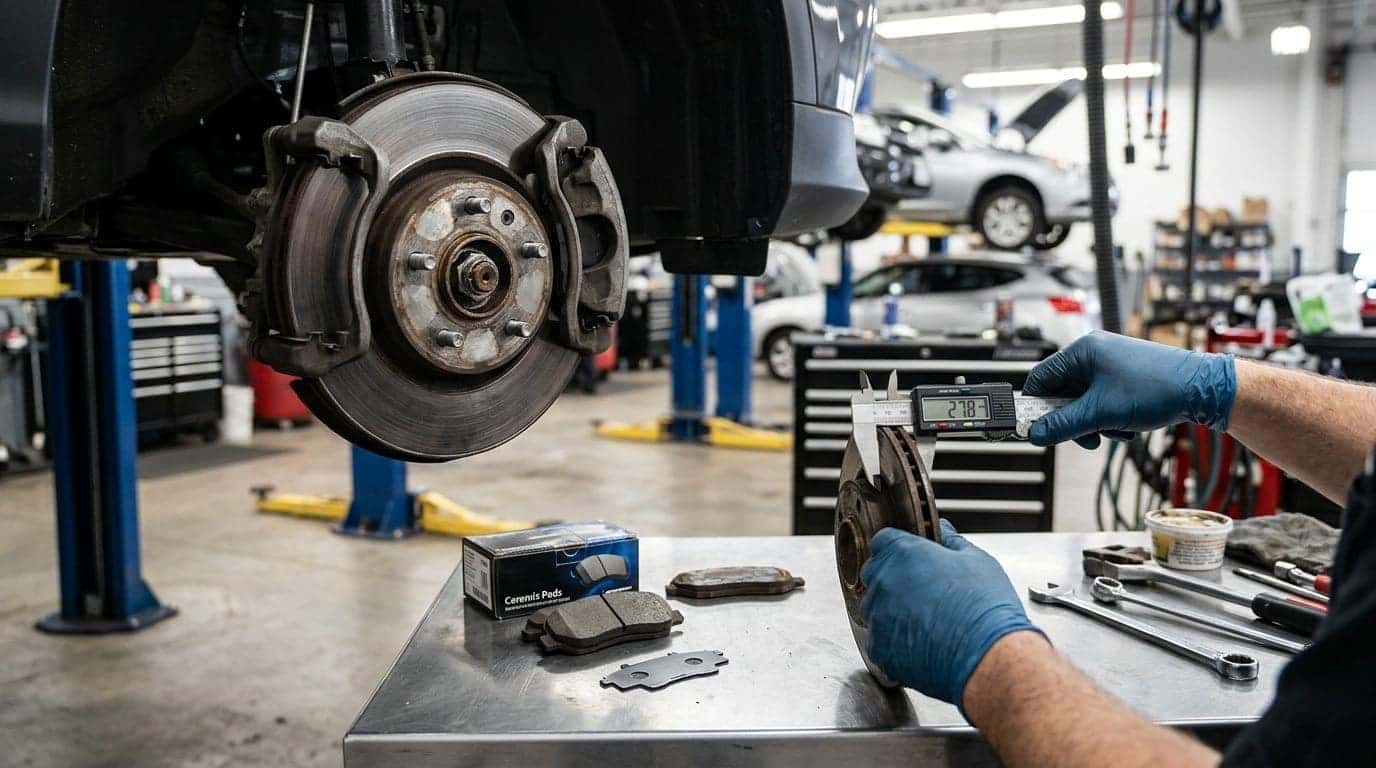
Brand-new original equipment brake pads typically feature 10 to 12 millimeters of usable friction material. During routine inspections, technicians measure remaining pad thickness using specialized digital calipers or manual feeler gauges:
- 10 to 8 millimeters: Friction material is in excellent condition.
- 7 to 5 millimeters: Normal mid-life wear; no immediate replacement required.
- 4 millimeters: Friction lining is approaching service thresholds; schedule upcoming service.
- 3 millimeters: Critical replacement threshold; wear indicators begin contacting the rotor.
- 2 millimeters: Extreme safety hazard; immediate pad replacement required to prevent structural backing plate failure.
Navigating the hilly agricultural routes and unpaved country roads around Royal places extra heat stress on brake assemblies, making routine millimeter measurements critical for preventing sudden brake fade. Rotors must also maintain sufficient metallic mass to absorb thermal loads. Every rotor features a minimum discard thickness specification cast directly onto the metal hub. Once machining or natural friction reduces rotor thickness below this dimensional limit, the rotor loses structural integrity and must be discarded. Drivers interested in vehicles thoroughly measured against these exact safety standards can examine our Newton Certified pre-owned vehicle program.
How Often Should Brake Fluid Be Tested and Flushed?
Brake fluid requires testing for moisture contamination during annual maintenance and a complete system flush every 30,000 miles or 24 months under normal driving conditions. Under severe driving conditions, such as continuous mountain transit or frequent heavy trailering, replacement intervals shorten to every 10,000 miles or 12 months.
Automotive hydraulic systems use glycol-based fluid (typically DOT 3 or DOT 4) because it maintains a high boiling point under immense pressure and acts as an internal lubricant for seals and pistons. However, glycol fluid is hygroscopic, meaning it continuously absorbs water vapor from the ambient air through microscopic pores in flexible rubber brake hoses.
As water content rises, the fluid’s boiling point degrades significantly. Dry DOT 3 fluid boils above 401 degrees Fahrenheit, but taking on just 3 percent water lowers its wet boiling point down near 284 degrees Fahrenheit. Under heavy braking, trapped moisture boils into steam bubbles inside the caliper cylinders. Because gas compresses while liquids do not, pressing the brake pedal compresses the steam instead of transferring force to the brake pads, causing the pedal to drop toward the floorboard.
Moisture also causes internal oxidation, corroding expensive ABS hydraulic control units, master cylinders, and internal caliper bores. Technicians test fluid health using optical refractometers, electronic boiling point testers, or chemical copper test strips. If you plan to upgrade your vehicle soon, you can use our online trade-in appraisal tool to determine your current car’s value before organizing maintenance.
How Much Does Brake Service Cost and How Does Rotor Resurfacing Compare to Replacement?
Standard brake pad replacement costs between $150 and $300 per axle, while comprehensive service involving new pads and rotors ranges from $300 to $800 per axle. Resurfacing existing rotors costs about $15 to $45 per unit in lathe labor when sufficient disc metal remains, whereas new replacement rotors range from $40 to $200 each depending on vehicle class and metallurgic design.
Rotor resurfacing—often called turning—uses a precision metal lathe to shave a microscopic layer of iron off the disc face. This process eliminates minor surface scoring, removes rust ridges, and restores a parallel friction surface for the new pads. Resurfacing is only appropriate when the rotor’s remaining thickness after turning exceeds the manufacturer’s strict discard limit.
| Service Option | Average Cost Range | Primary Advantages | Operational Limitations |
|---|---|---|---|
| Rotor Resurfacing (Turning) | $15 to $45 per rotor (labor) | Retains factory metal; lower immediate repair cost | Requires adequate remaining thickness; cannot fix deep cracks |
| Rotor Replacement | $40 to $200 per rotor (parts) | Restores full factory heat sink mass and durability | Higher initial hardware investment |
When rotors suffer deep heat checking, severe rust pitting, or heavy grooving from worn pad backing plates, resurfacing removes too much metal, causing the rotor to drop below safety tolerances. Installing new rotors ensures maximum structural mass for heat dissipation. When planning vehicle upkeep, drivers can check our genuine OEM Nissan parts center for factory components, browse our key fob replacement services for minor vehicle maintenance, or read our buying versus leasing guide when weighing repair costs against a replacement vehicle.
How Long Does a Typical Brake Service Take?
A routine single-axle brake pad replacement takes approximately 30 to 60 minutes in an equipped service bay, while replacing both pads and rotors on one axle requires 45 to 90 minutes. Servicing all four wheels with new friction components and performing a full hydraulic system flush typically takes between 2 and 4 hours.
When vehicle owners stop by our service desk, they often ask whether a comprehensive brake inspection can be performed concurrently with a standard oil change and tire rotation. Service timelines depend on structural cleanliness, hub corrosion level, and system accessibility:
- Inspection and Teardown (10 to 15 minutes): Vehicle hoist setup, wheel removal, caliper unbolting, and pad/rotor thickness measurement.
- Hub Prep and Cleaning (15 to 20 minutes): Removing hub face corrosion with wire abrasives to prevent lateral runout on the new rotor assembly.
- Component Installation (15 to 30 minutes): Fitting new clips, lubricating caliper slide pins, installing pads, and torquing caliper bolts to factory foot-pound specifications.
- Hydraulic Service and Bed-In (15 to 30 minutes): Flushing brake lines if scheduled, verifying pedal pressure, and performing a controlled road test to bed in the new friction material.
Unexpected delays occur when caliper slide pins seize from road grime, slide dust boots tear, or rust fuses the rotor hub to the axle flange. To lock in your maintenance window, you can schedule brake service online in advance. We also offer flexible service payment options to help manage maintenance schedules easily.
Common Questions About Nissan Brake Maintenance Timelines
Q: How do electronic parking brakes affect rear brake pad servicing?
Vehicles equipped with electronic parking brakes require a specialized service mode to retract the electric caliper servo motors before hardware removal. Attempting to manually compress the rear caliper pistons without engaging service mode via diagnostic tools will destroy the internal motor gears and screw mechanisms. Once service mode is activated, technicians compress the piston normally, replace the pads, and calibrate the electronic parking actuator.
Q: Why do newly installed brake pads occasionally make a faint squeaking noise?
Minor high-frequency squeaking on brand-new brake pads usually occurs during the initial bed-in period as the fresh friction material transfers an invisible microscopic layer of compound onto the rotor face. This light transfer layer promotes smooth stopping performance. If high-pitched squealing persists past 200 miles of city driving, it points toward dry caliper slide pins, missing anti-rattle clips, or unlubricated pad backing plate contact points.
Q: Is it safe to replace brake pads on only one side of an axle?
Brake pads must always be replaced in complete axle sets across both left and right wheels simultaneously. Replacing pads on only one side creates a friction imbalance between the wheels, causing severe vehicle pulling toward the side with higher grip under heavy braking. Uneven pad replacement also destabilizes the ABS and electronic stability control algorithms during emergency stopping maneuvers.
Q: What causes brake dust to accumulate more heavily on front wheels?
Front wheels generate significantly more brake dust because standard passenger vehicles experience forward weight transfer during deceleration, shifting up to 70 percent of total stopping force onto the front axle. Consequently, front brake pads are larger and work much harder than rear pads. Many manufacturers also spec higher-friction pad compounds for front calipers to handle elevated thermal loads, resulting in faster compound wear and darker dust buildup.
Q: What documentation should I retain to keep my brake warranty coverage intact?
Always keep itemized repair invoices showing the date, vehicle mileage, specific parts installed, and exact services performed during maintenance visits. Documenting that brake fluid flushes and friction inspections occurred within manufacturer mileage windows protects your powertrain and component warranty claims. Keeping detailed records also demonstrates documented maintenance history, which optimizes vehicle resale valuation.
Maintaining your vehicle’s braking performance protects your family and preserves overall vehicle longevity. Our factory-certified technical team at Newton Nissan South is ready to conduct precision thickness measurements, fluid analysis, and complete system service. Reach out to our advisors directly at (931) 536-3118 to discuss your service schedule, or visit our Shelbyville location for an in-person multi-point brake evaluation.
0 comment(s) so far on What Are the Warning Signs That Your Vehicle’s Brakes Need Service?